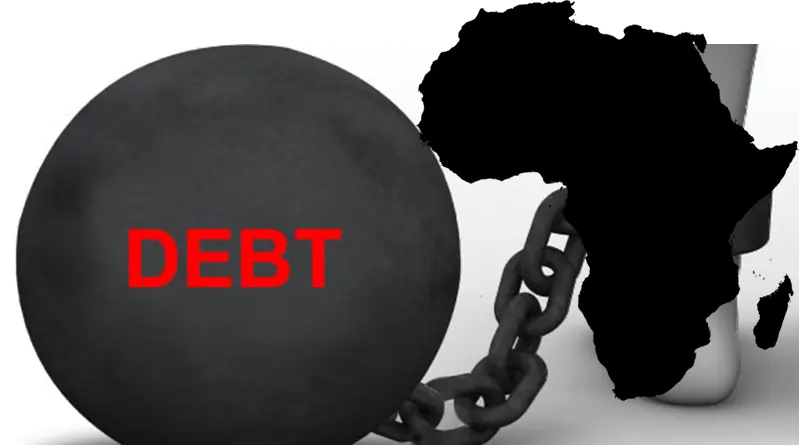
ABUJA, Nigeria-As Africa’s public and external sovereign debt surges to a historic $1.8 trillion, economists and policymakers across the globe are sounding the alarm—and, in a surprising twist, some are calling for more borrowing, not less.
New figures from the African Development Bank (AfDB) reveal the continent’s debt has grown by 170 percent since 2010, with external interest payments expected to reach $20 billion in 2025.
For Sub-Saharan Africa, this statistic alone equates to 3.4 percent of GDP, straining budgets and threatening development progress, even as some countries are being asked to go slow on borrowing or borrow less.
Renegotiate Loan Payments
Economist George Kabongah wants the countries to reduce their borrowing appetite. “Lets now focus on renegotiating for long term repayment periods,’’ he suggests.
Today, data shows how massive debt is heavily concentrated in the continent’s largest economies.
Egypt and South Africa account for nearly 30 percent of Africa’s external liabilities.
On the other hand, Nigeria, Angola, Kenya, Morocco, Ghana, Mozambique, Tunisia, and Sudan comprise most of the remainder, thus reaffirming how indebted the industrialising countries are.
Alarmingly, private bondholders now own 54 percent of Africa’s external debt, up from just 18.8 percent in 2008—making African economies more vulnerable to global interest rate shocks and capital market volatility.
At the 32nd Annual Meetings of Afreximbank came to a close in Nigeria, a bold alternative vision emerged from some of the respected economists across the globe.
“Africa needs more debt, not less debt,” declared Professor Jeffrey Sachs, renowned development economist and Columbia University scholar-unexpected proposal that turned the conversation on its head.
The statement rang through the halls with provocative clarity, “Africa needs more debt, not less.”
It was a startling claim in a room long haunted by debt crisis conversations and the way forward thereto key.
Yet, Sachs was not advocating for recklessness. Instead, he envisioned a radically restructured financial paradigm—one where debt becomes catalytic, not crippling.
Growth York
Sachs argued that the continent cannot grow without large-scale investment in infrastructure, education, and industrial capacity and that more resources still need to be channelled to these sectors.
He proposed a new economic blueprint: infrastructure investment equivalent to 40 percent of GDP, universal secondary education, and an aggressive “Made in Africa 2035” strategy to drive industrialization.
His vision is anchored on Africa’s unique demographic advantage—home to one of the world’s fastest-growing and youngest populations, which he asserted must be explored for industrial growth.
“There are three places with 1.5 billion people—China, India, and Africa,” Sachs said.
“Africa’s turn starts today,’’ he disclosed even as public coffers are groaning under the weight of Africa’s interest payments alone—$20 billion in external debt whose servicing is due this year.
This is also likely to consume about 3.4 percent of Sub-Saharan Africa’s Gross Domestic Product (GDP), according to economic experts’ analysis and predictions ahead.
For a continent brimming with potential, these figures are more than just economic metrics—they are symptoms of a deeper structural strain, which, if not checked, will affect the continent’s 2063 economic agenda.
But amid the gloom of mounting liabilities, Prof Sachs’s radical shift in narrative is emerging—one that challenges conventional thinking and dares to recast debt not as a burden, but as a tool for transformation.
According to the African Development Bank and other financial monitors, just two nations Egypt and South Africa account for nearly 30 percent of the continent’s external debt.
Kenya’s Sh11 Trillion Debt
In Kenya, National Treasury CS FCPA John Mbadi has disclosed that Kenya’s public debt hit about Sh11 trillion by January 2025—split roughly equally between domestic Sh 5.9 trillion and external Sh5.1 trillion debt—with debt-to-GDP peaking at around 65.7 percent but declining from about 72 percent.
The goal is to reach the legal ceiling of 55 per cent by 2028/29, with Mbadi revealing that Kenya won’t default on its debts, noting that debt is sustainable, but the challenge lies in liquidity due to debt maturities clustering between now and 2032.
He is on record defending the plan to continue borrowing—domestically and externally—to refinance maturing debt and fund operations, including tapping a recent $1.5 billion UAE bond and a $1.5 billion 10‑year Eurobond.
Mbadi has also announced a fiscal consolidation plan aimed at reducing the fiscal deficit progressively—targeting 4.3 percent of GDP for 2025/26—to lower accumulation of public debt and to replace costly loans with cheaper domestic borrowing.
What is more telling about African countries sovereign debts, however, is the shifting landscape of creditors: private bondholders now own 54 percent of Africa’s external debt, up from just 18.8 percent in 2008, a sign of growing reliance on volatile capital markets, according to Sach.
“This dependency comes at a cost. Credit ratings remain unfavourable, borrowing costs remain high, and nations often find themselves trapped in cycles of refinancing rather than growth,’’ Sach claimed.
Alongside Sachs’ statement, Singaporean diplomat and economic development strategist Dr. Kishore Mahbubani offered hard-won lessons from Asia’s rise.
“Development is extremely difficult,” he warned, invoking Vietnam’s missteps and Singapore’s calculated wins.
But with focus, discipline, and an ecosystem that rewards ambition, Mahbubani believes Africa can follow suit—if it learns the right lessons.
‘Sovereign Ceiling’
For all its demographic and resource strengths, Africa remains a financial underdog.
“The world saves $30 trillion a year,” Sachs said. “Africa gets a trickle. Sometimes, net flows are negative. This ought to change.”
Much of this imbalance is embedded in a global financial architecture designed without Africa in mind.
Sachs lambasted credit rating agencies for applying cookie-cutter metrics that ignore nuance and unfairly penalise risk.
He challenged the so-called “sovereign ceiling” doctrine that limits African corporations from being rated higher than their governments—an outdated model that stifles private investment and growth.
Now Africans have decided to develop their own credit rating agency, which is coming soon, according to Dr Meshack Mituse from the African Unions-APRM, a body charged with universal policy reviews.
“We are developing our own rating and reporting debt standards,’’ he disclosed, saying some of the latest ratings on countries like Kenya and Afreximbank have been biased.
Instead of fighting for space within a rigged system, Sachs urged Africa to seek alternative capital sources: China’s Belt and Road, Gulf sovereign wealth funds, and India.
But beyond capital, he called for a reimagined relationship with finance—one rooted in long-term partnerships, not short-term returns.
Mahbubani echoed that sentiment, pointing to inefficiencies within Africa’s fragmented markets.
“Africa’s 55 economies must function as one,” he said. Only through fiscal and infrastructural integration can the continent harness its true potential.
At the centre of this transformative agenda stands Afreximbank, helmed by Professor Benedict Oramah, whose tenure has been nothing short of revolutionary.
From $5 billion in assets a decade ago, the bank now commands over $37 billion, having mobilised $250 billion in trade and development financing across Africa. Nowhere is this impact more visible than in Nigeria.
Under President Bola Tinubu, the country has become a laboratory for bold economic reform—removing fuel subsidies, unifying the naira, and investing in critical infrastructure.
With over $52 billion in financing from Afreximbank, Nigeria has seen transformative projects take root: from the Dangote Refinery to the African Medical Centre of Excellence and the Pan-African Payment and Settlement System (PAPSS)—a platform Tinubu described as a “shield” against financial volatility.