Inspired by the COVID-19 hygiene lessons, the smart bin opens automatically for users within 30 cm -a no-touch fix for schools, hospitals and Persons with Disabilities (PWDs)
KISUMU, Kenya, 14th April, 2016 –On a sunny Wednesday morning, as a group of learners engage in various activities on a school playground, two learners, Shanice Achieng and Cassie Winley, are not among them.
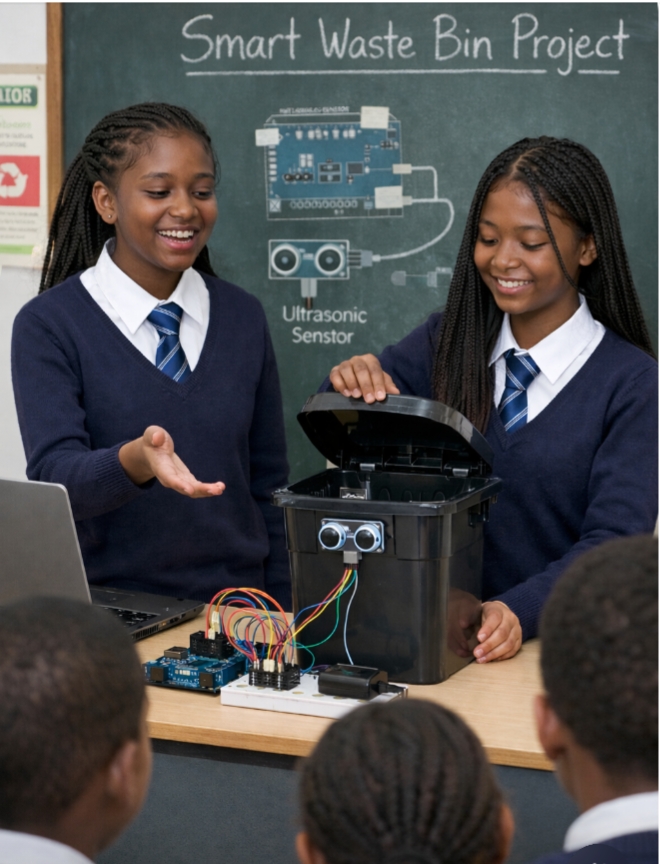
The two Grade Seven learners at Green View Academy in Kisumu City, are busy demonstrating their automatic garbage bin innovation to a group of students in the school library.
They move closer to the garbage bin, which opens and closes after a few seconds, allowing waste to be discarded.
For learners in the Competency-Based Education (CBE) system, this is one of many innovation projects they hope to pursue, dreaming of becoming engineers someday.
“Cassie and I have been working with our Information and Communication Technology (ICT) teacher for the last two weeks to develop the smart garbage bin,” says a smiling Shanice.
She says the idea for the smart garbage bin was inspired by their desire to find a waste disposal point that does not require physical contact, either using the leg or hand.
This initiative was prompted by their observations of shopping malls, hospitals, and schools using pedal-operated waste bins.
COVID-19 Lessons
The learner explains that, just like during the COVID-19 pandemic when physical contact was discouraged, the smart bin would help prevent such situations.
“We also have people who cannot use their legs due to age, illness, or disability. Our smart bin is one of the best solutions for them,” says the 13-year-old.
Cassie, who aspires to study modern technology in the near future, explains that the smart waste disposal device is made of an Arduino Uno, jumper wires, a motor, an ultrasonic sensor, and a 12-volt adapter.
Once connected to a power source, the device detects motion and sends signals to the Arduino Uno.
The motor then activates, automatically opening the bin, which closes after a few seconds.
“Our smart sensor dustbin uses electricity from a standard dual socket, which supplies 240 volts. Since Arduino Uno cannot handle such high voltage directly, we use a 12-volt adapter to convert it,” she explains.
According to her, the equipment can be used in offices, hospitals, and schools as long as there is a stable power supply.
She notes that the device consumes minimal electricity, making it suitable for both high and low-income settings.
“We are already using the innovation in our school, and we hope to achieve our goal of maintaining a clean environment,” she states.
She adds, “A clean environment also helps protect us from germs that cause diseases while ensuring we attend school regularly.”
Coding Ideas
Mr Hillary Omondi, a teacher at Green View Academy, says the learners developed the idea during a coding class and decided to bring it to life.
He explains that the smart bin, which automatically opens when a user is within 30 centimetres, is suitable for schools where younger students might be exposed to germs via contact with waste.
“Several young learners are likely to come into contact with the bin, and if they don’t wash their hands properly, they risk exposure to sanitation-related diseases,” he states.
He notes, however, that the innovation can only be used where there is a reliable power supply and within buildings to prevent short circuits during rainy weather.
Mr Omondi emphasises that creating such innovations helps learners achieve basic CBE goals like problem-solving, critical thinking, and innovation.
“I realised that involving learners in such activities boosts their morale and motivation to explore fields they are interested in,” he says.
He concludes, “Introducing them to these activities also helps them decide on their career paths early, unlike the previous system where students struggled to choose careers due to late exposure.” Image Courtesy of ChatGPT
akinyimagak@gmail.com