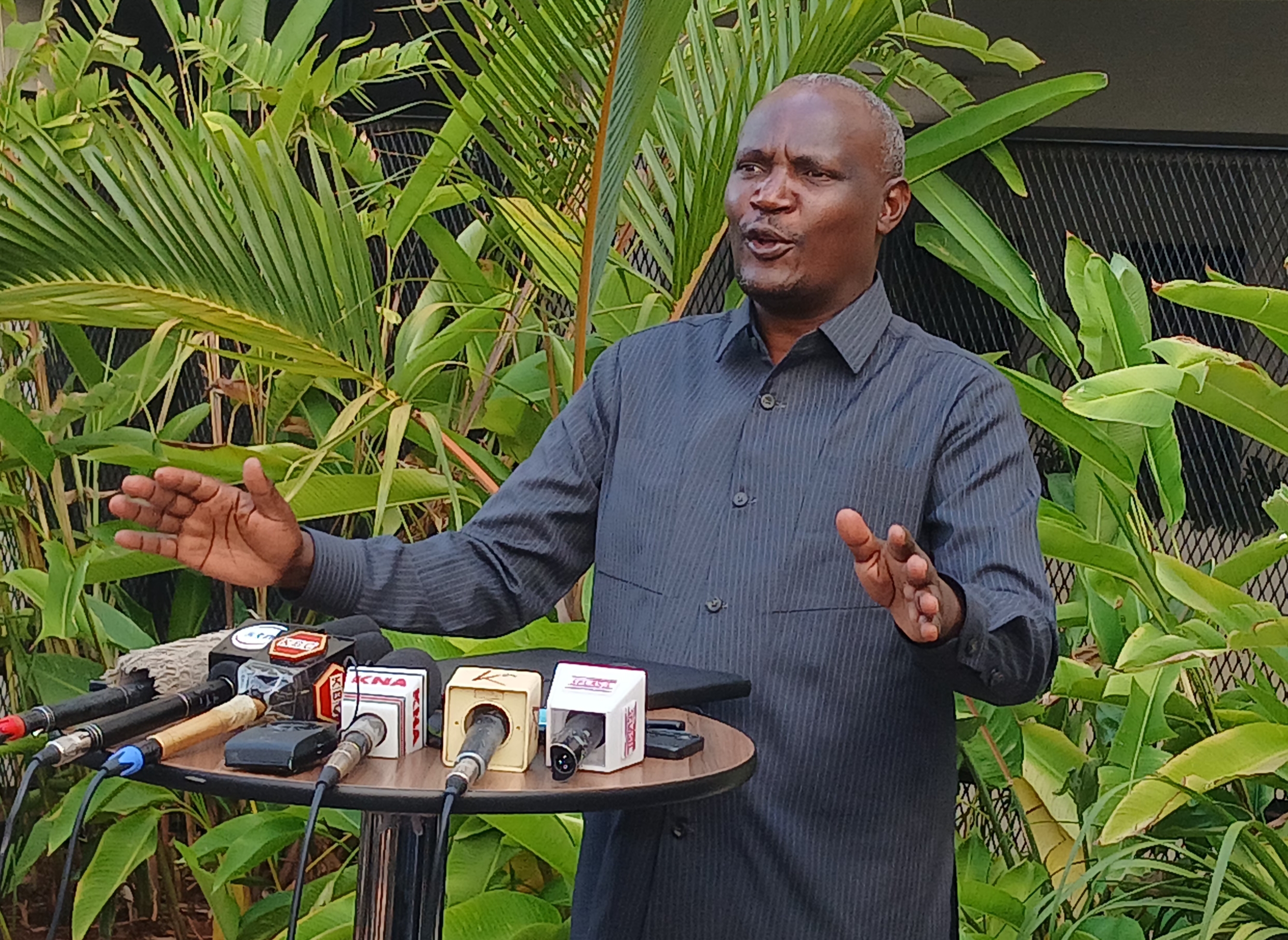
KISUMU, 16th Sept 2026 – National Treasury and Economic Planning Cabinet Secretary (CS) John Mbadi has defended the current state of the economy, saying the government has put it on a stable path.
Addressing the press in Kisumu today, CS Mbadi said there is liquidity in the economy, with the government releasing funds to counties, constituencies and for salaries on time.
“Some people are saying that there is no money in people’s pockets. The truth is, the government is releasing money. There is liquidity. All counties are getting money. Are you hearing any complaints from counties? Governors used to call press conferences over delayed funds. They are no longer doing that,” Mbadi said.
He said the National Government Constituencies Development Fund (NG-CDF) is now being released monthly, something that had never happened before.
“Every month, in July I released. It is only this September that we have not released CDF. I am releasing CDF every month. We are releasing Sh5.3 billion every month to CDF, meaning liquidity. That is how to give liquidity to the economy,” he said.
The CS added that payment of government employees has also normalised.
“By the 5th, we have paid all salaries. When I got into this ministry, by the 15th, 20th, even 27th of the month, salaries for the previous month had not been paid. And then you hear people say that this economy is not run well,” he said.
Mbadi said those criticizing the government should offer alternatives on how the economy should be managed.
“If they think that we are not running the economy well, let them tell us how they want it to be run. As far as I’m concerned, we are doing our best,” he said.
On the report by the Controller of Budget that flagged opaque expenditure under security operations, Mbadi said the expenditure was not hidden but provided for in the Charter of Accounts.
“First, security operations can never be open. If you can see it is a security operation, then how is it open? And you cannot say that the budget line is ‘other expenditure ‘; then that is opaque. Other expenditure is one of the items that is provided for in the Chart of Accounts,” he explained.
He clarified that the item in question was the leasing of police vehicles, domiciled at the National Treasury since former President Uhuru Kenyatta was Minister for Finance.
“If you ask me, I would tell you. The security operation is the leasing of police vehicles, which is domiciled at the National Treasury. And if you lease police vehicles at Sh7 billion, what is the problem?” he posed.
On debt management, the CS said the government’s priority has been to slow the rate of debt accumulation and avoid default.
“There is no country in the world that does not have debt. America, which is the largest economy, has the largest debt. What an economy should do is to slow the rate of debt piling,” he said.
Mbadi noted that Kenya had been listed among countries at risk of defaulting, alongside Ghana, Chad and Mozambique, but the government undertook liability management to avert it.
“We have made sure that we have smoothed the curve. We have dealt with debts that were maturing in the near future. In 2027 and 2028 there was no spike; in 2029, 2030 and 2032 we didn’t have much. 2031 is the only spike that is remaining in terms of external commercial debt,” he said.
He said multilateral debts are cheap and manageable, while bilateral debt, especially with China, has largely been managed with support from the Chinese government.
“We have a little bit of an issue with domestic debt. So what have we done? We have so much short-term debt. We have tried as much as possible to lengthen the tenure. We have borne more on long-term bonds as opposed to short-term debt,” Mbadi said.
He attributed the stability of the shilling, record foreign exchange reserves and positive ratings by credit rating agencies to prudent debt management.
“That is why we have one of the most stable currencies on the continent. That is why we have one of the highest foreign exchange reserves in the history of this country. That is why we have now been rated positive by all credit rating agencies from 2024 to date,” he said.
On the Sh86 billion expenditure flagged by the Controller of Budget, Mbadi said it was used to buy back the Eurobond ahead of a Sh1.5 billion maturity in May.
“How could I have predicted that the market was going to be good, that interest rates were going to come down? If you allow yourself to reach December this year without a plan to pay, the shilling would have been at Sh182 to the dollar. That is simple economics,” he said.
“The moment you see the market open, if you are intelligent enough, mean well for your country, and you are thinking smart, the first thing to do is to move quickly and do liability management. And that’s what we did. I will do it tomorrow and any other day to protect the Kenyan economy,” Mbadi added.