KISUMU,October 2026 -For centuries, religion has been seen as an important part of life, with some people seeing it as the foundation of all decisions and life itself.
Specifically, in the Middle Ages, from the 5th to the 15th centuries (approximately 400 CE–1500 CE), religion was not just a personal belief system; it played a significant role in law, politics, education, science, daily labour, and community structures in many societies, although its influence varied across regions and cultures.
However, there have been significant changes, especially involving the younger generations (Millennials and Gen Z), with some either fully distancing themselves from religious practices or establishing strong boundaries and using logical thinking in decision-making, rather than relying solely on what religion says.
According to research from the Barna Group, 42% of U.S. adults report that they have deconstructed the childhood faith they were raised with. Although this figure is not specific to younger generations, it highlights how religious deconstruction extends beyond a single age group.
Of course, not every young person experiences religion in the same way, and these changes do not mean that all young people are moving away from religion. However, it is interesting to explore why more of them are questioning what they were taught and choosing to approach faith differently.
The big question is, what changed? Why do the younger generations no longer follow religion blindly? Why do they actually look for something deeper than the ‘rules’?
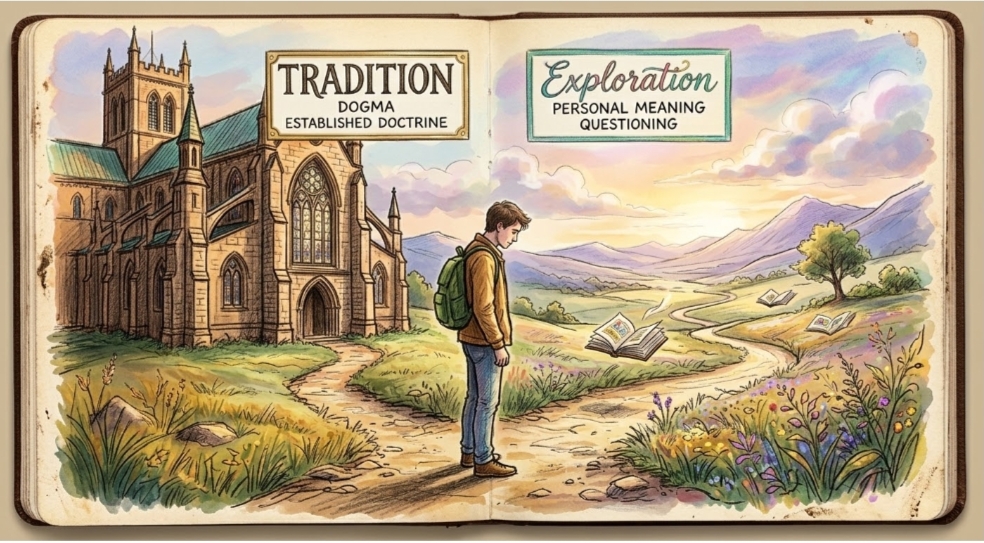
Before we get into it, one might ask, what does deconstructing religion mean? Religious deconstruction is the process whereby a person critically re-examines, questions, and systematically dissects the religious beliefs, doctrines, and cultural habits they grew up with.
The term borrows loosely from Jacques Derrida’s philosophical concept of deconstruction, which emerged in the 1960s (the dismantling of texts and assumptions), and it rose to prominence within American evangelicalism and the “exvangelical” movement.
As someone who was born and raised Christian and respects all religions out there, I will mostly focus on Christianity, as it is what I am most familiar with.
1. Experience Is The Best Teacher
The younger generations have grown up during some serious social issues, like financial corruption, political polarisation, abuse in religious organisations, etc. Christianity, for instance, says to respect and obey those in authority, something that the older generations also struggled with, especially when these people were dictatorial, selfish, and the cause of wars, hunger, and financial crises.
The younger generations are among the boldest out there, and they aren’t afraid of calling out the double standards of religion and the leadership styles of governments and religious leaders. When these same people in authority weaponise the Bible, for example, it erodes credibility and prompts individuals to re-examine the system as a whole.
2. Social Media
With the internet and social media, young adults are exposed to diverse worldviews, comparative religious studies, historical critiques of sacred texts, and scientific developments far more easily than previous generations. This makes it easier for them to actually compare what they were taught with what others were taught and with the actual reality of life. It enables more people to learn, express themselves, and advocate for what they believe in.
3. Strictly Follow Religion or Have Basic Human Decency?
The sharp disconnect between traditional religious stances and young people’s values regarding LGBTQ+ inclusion, gender equality, racial justice, and social equity has caused even more people to deconstruct religion. Most young people ask themselves questions like why men are considered superior and whether this gives leeway for femicide, abuse, gender-based violence, and a lack of independence for women.
In other words, they question the idea that women are born solely for men and not to be their own people. At the same time, restrictive religious expectations and traditional gender roles can affect men, too. Many men also actively challenge inequality and stand up for women’s rights and the rights of other marginalised groups.
Unlike the older generations, many younger people place great emphasis on equality and loving and respecting everyone regardless of their gender, sexual orientation, race, social status, and other limiting factors. It is, of course, still a work in progress. However, when institutional doctrine conflicts with their personal ethics, many choose to align with their moral convictions over religious allegiance.
Personally, I noticed that conservative religion is against divorce, something that is still followed by the Roman Catholic Church, especially in Africa and the Philippines. This absolutely makes no sense to me because what do you mean you have to endure living with an abusive man who might even kill you, or you’ll go to hell for divorcing him?
That just sounds extremely wrong. I wonder why mostly the marginalised and vulnerable groups have to endure all sorts of things just for religion.
4. Judgement Leading to Deconstruction
Deconstruction often begins when individuals feel their honest doubts, complex questions, or existential struggles are met with judgement, dismissal, or legalistic responses rather than open dialogue. The main questions I received from three people who deconstructed are: The Bible says judgement belongs to God, so why am I judged for being myself, and why are LGBTQ+ people judged, hated, and killed?
The Bible says to love your neighbour; why do people still force children into marriages while everyone else turns a blind eye? Why are people selective about what is acceptable and what is not? Why is sexual orientation, which doesn’t realistically affect others, considered worse than femicide, child sexual abuse, child marriage, corruption, religious abuse, and cults, all of which directly harm far more people?
I honestly wish I had the answers to their questions. Hopefully, one day, we’ll get answers.
5. Evolution of Individualised Spirituality
Deconstruction does not always lead to atheism. Research suggests that while formal participation in organised religion is dropping, many young people retain personal spiritual practices like prayer, meditation, or a broader belief in a higher power, reframing faith on their own terms outside institutional walls.
This can mostly be attributed to what is happening socially with governments and religious institutions that preach water and drink wine. Instead of getting more discouraged by the double standards, most young people have opted to have a personal relationship with God or a higher power without involving a third party.
To cut the long story short, people often begin deconstructing because of church hurt or institutional hypocrisy, political or nationalist alignments within religious groups, exposure to alternative worldviews, or internal moral and intellectual questions about scripture.
This often leads to one of two outcomes:
Reconstruction: Retaining, reshaping, or rebuilding a healthy, customised spiritual foundation.
Deidentification or Deconversion: Stepping away from the religion entirely, leading to agnosticism, atheism, or complete disaffiliation from institutional faith.
Ultimately, religious deconstruction is a personal journey, and there is no single experience or reason that explains why people question their faith. For some, it means finding a different way to understand and practise their religion, while for others, it means stepping away from it entirely. Others may continue to believe in God while questioning religious institutions, doctrines, or the people who interpret them.
As society continues to change, the relationship between younger generations and religion will likely continue to evolve. Whether someone chooses to remain religious, redefine their faith, or leave religion altogether, the reasons behind that decision deserve to be understood within the context of their individual experiences, values, and beliefs.
Rather than assuming that everyone who questions religion has lost their way, perhaps it is worth recognising that questioning, just like believing, can be part of a person’s search for understanding, meaning, and a way of life that aligns with their convictions.
Deconstruction often begins when individuals feel their honest doubts, complex questions, or existential struggles are met with judgement, dismissal, or legalistic responses rather than open dialogue. The main questions I received from three people who deconstructed are: The Bible says judgement belongs to God, so why am I judged for being myself, and why are LGBTQ+ people judged, hated, and killed?
The Bible says to love your neighbour; why do people still force children into marriages while everyone else turns a blind eye? Why are people selective about what is acceptable and what is not? Why is sexual orientation, which doesn’t realistically affect others, considered worse than femicide, child sexual abuse, child marriage, corruption, religious abuse, and cults, all of which directly harm far more people?
I honestly wish I had the answers to their questions. Hopefully, one day, we’ll get answers.
5. Evolution of Individualised Spirituality
Deconstruction does not always lead to atheism. Research suggests that while formal participation in organised religion is dropping, many young people retain personal spiritual practices like prayer, meditation, or a broader belief in a higher power, reframing faith on their own terms outside institutional walls.
This can mostly be attributed to what is happening socially with governments and religious institutions that preach water and drink wine. Instead of getting more discouraged by the double standards, most young people have opted to have a personal relationship with God or a higher power without involving a third part