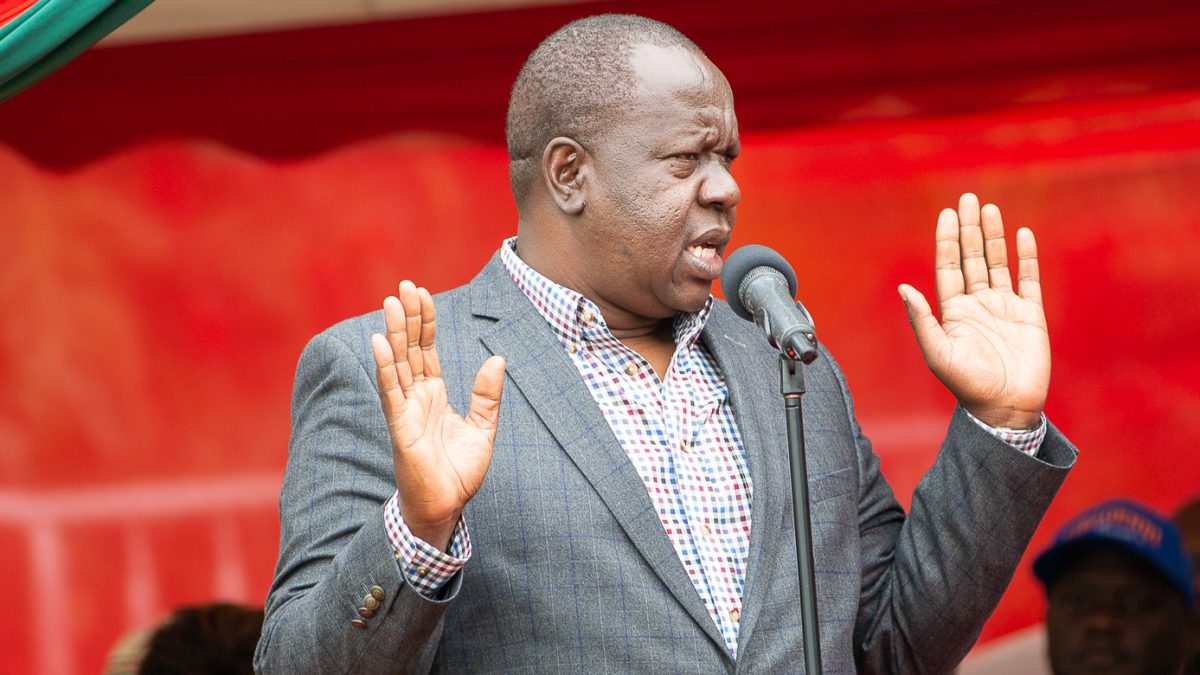
NAIROBI, Kenya, 19th November -Jubilee Deputy Party Leader Dr Fred Matiang’i has denounced his involvement in the extrajudicial killings and called for the immediate formation of a fully fledged public inquest into the numerous bodies of Kenyans dumped into the River Yala in Gem, Siaya County.
This, he says, follows incessant calls for him to shed more light on the incidents such as the mysterious death of about 30 people while in police custody, Kerio Valley killings and Shakahola massacre (in court), despite responding to the matters severally.
The incidents occurred while he served as the powerful Interior Security and National Coordination Cabinet Secretary (CS )in the fourth President Uhuru Kenyatta’s tenure.
The 2027 Jubilee presidential torchbearer says that the inquest should be headed by a Magistrate or a person of high repute.
In a statement akin to kila mtu atabebe msalaba wake (Everyone will carry their own cross), Dr Matiang’i says that: “he is very clean and wasn’t involved, as he suggests that the inquest will set the record straight.”
“Today marks the sixth time I have responded to this issue. If anyone is in doubt and doesn’t trust the work of Directorate of the Criminal Investigations (DCI), then let’s create a fully fledged public inquest, and I am willing to go there even tomorrow, and I hope every member of the National Security Council that I served with (will do the same), so that every one of us can say what they know, and determination will be made on who has the responsibility,” he said during a morning interview with a national TV broadcaster on Wednesday, 19th November.
“We should not politicise the issue because it’s politically convenient to do so. On River Yala, bodies were found, just like say for example in a trench near Kahawa Sukari or Mombasa road, the first action is investigations by the police.”
But when it reaches a worrisome scale, Dr Matiang’i explained that it captures the attention of the national security infrastructure: taken by the National Security Advisory Committee, then to the National Security Council headed by the President.
At that time, he continues, the head of state (Uhuru Kenyatta) demanded responses from the police and DCI. “We even explored the possibility of a fully fledged inquest to get the systematic ways into the murder.”
“But, then the police said no as they suggested that when we have got bodies, then it means we have a point of departure to start investigations: we will examine the bodies, conduct post mortems, get reports and open the files,” Dr Matiang’i narrated.
“When we have the body of a certain person, we can ask ourselves to know where this fellow was? When did he disappear, and piece the pieces together? It will enable us to conduct an investigation into how this person met their death and their bodies were found in River Yala.”
He said that the police department is an independent institution under the law (Chapter 218), and unlike the past, the CS can’t willingly appoint, fire or move officers of any rank.
“What happens is that the minister coordinates on behalf of the President. The responsibilities in the security sector, are both individual and collective, and the police have standing orders.”
He further pointed out that the policing in this country has the theories and ideologies that are intended to keep law and order and keep the country secure.
“What this means is that the police are trained, hired, and they know that every responsibility they take is graduated either at the collective level, and that’s why the command takes responsibility or to the individual in terms of how the act can point to one or another,” Dr Matiang’i stated.
Crimes, he said, do happen and the police have standing orders. It’s because everyone knows that an individual police officer may act outside of the law or the standing orders.
Also, in the security sector, Dr Matiang’i noted that the police department has disciplinary measures under Unorderly Wrong Proceedings and Court Martials for the military, to discipline its errant members.
“When actions happen and most of them are criminal, then the law takes its course. I said it several times before, and today I will say it for the rest of my life that when actions happen in government, we go the investigation way and follow where it takes us.”
Referring to the constitution, he stated that the minister for interior is not above the law, and I have never been above the law in all my life, even when I was holding that docket, because the law is very clear: when one has committed certain offences, he is prosecuted.
“Every time as Cabinet Secretaries, we used to consult the Attorney General Prof Githu Muigai and Justice Kihara Kariuki when we were not sure of our next course of action: they would advise us that you only have sentiments, the law, but can’t act.”
According to Dr Matiang’i, a clear, objective and robust investigation will ”reveal those who pulled the strings in the background.”
He also challenged President William Ruto to establish the commission to address State Capture as they promised during their 2022 election campaign, as he expressed his willingness to appear and testify.
“If a minister, for example, gives an order or direction, or asks Police officers to do something illegal, the investigations will point to that particular minister. And there’s nowhere to hide, however much powerful he is, because some of these criminal acts aren’t covered by the statutes of limitations. You can leave the office today, and you will still be hounded before a judge for your actions.”
Photo|X@Dr.Fred Matiang’i
.