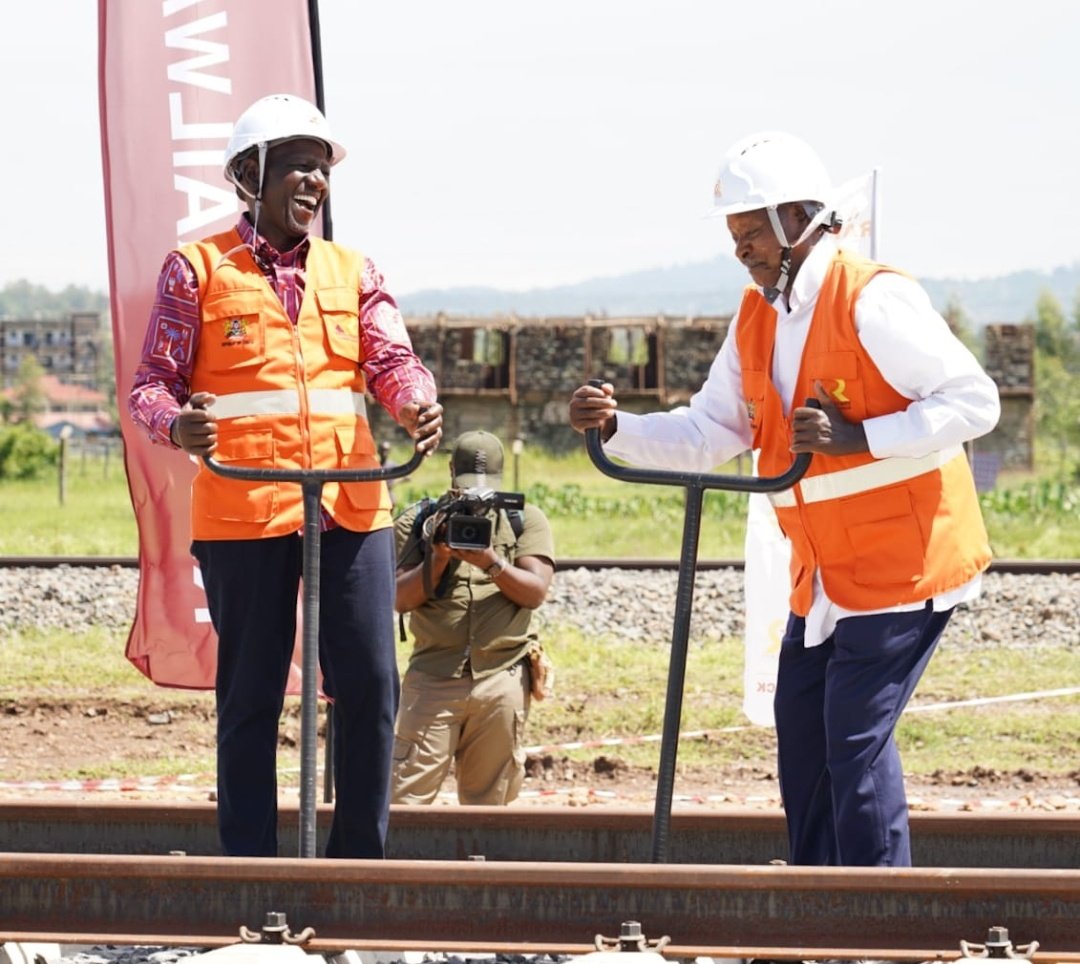
KIBOS, Kisumu, March 21 -In a historic display of unity and shared ambition, Kenya and Uganda have taken a decisive step to redefine the economic geography of East Africa.
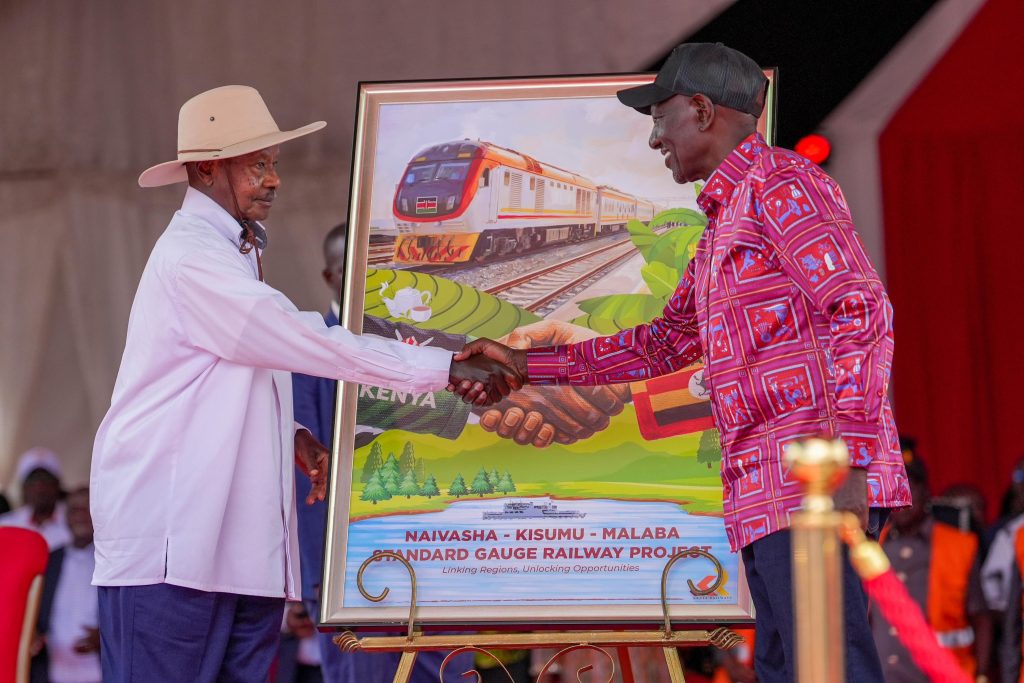
The ground-breaking ceremony for the Kisumu-Malaba section of the Standard Gauge Railway (SGR) marks not merely the continuation of a national infrastructure project, but the forging of a transformative regional artery designed to bind the destinies of East and Central Africa.
Gathering in Kibos, Kisumu, President William Ruto and his Ugandan counterpart, President Yoweri Museveni, presided over the launch of the 107km section that completes a nearly 1,000km seamless rail link from Mombasa to Malaba.
This final phase, following the recent ground-breaking of the 264km Narok-Kisumu section (Phase 2B), transforms the SGR from a national asset into a continental gateway, directly connecting Kenya’s industrial corridor to the agricultural heartlands and onward to Uganda, and ultimately serving partner states including Rwanda, Burundi, South Sudan, the DRC, and the Central African Republic.
President Ruto framed the project within a broader historical context, contrasting it with the colonial-era Uganda Railway, which was built 130 years ago to serve the interests of extraction and territorial control.
“Infrastructure development does not just connect places; it often creates them. It determines where opportunity lives, where investment flows, and where prosperity takes root,” he stated.
He lamented that the old metre-gauge railway, once a lifeline for regional commerce, had fallen into disrepair, losing its vitality. However, the vision for a modern, high-capacity link never faded.
President Ruto paid tribute to the enduring vision of the late President Mwai Kibaki and President Museveni, who in 2008 laid the foundation for a modern railway linking Mombasa to Kampala. He further acknowledged the collective leadership of Kenya, Uganda, and Rwanda in signing the SGR Protocol and Tripartite Agreement to ensure a seamless railway system.
“Thank you, Mzee, for your leadership, your vision, and your steadfast commitment to the unity and integration of our region,” Ruto said, addressing President Museveni.
For his part, President Museveni hailed the project as a key pillar in rationalising East Africa’s transport system.
“By shifting bulk cargo from roads to rail and pipelines, we reduce transport costs, protect infrastructure and improve efficiency,” Museveni said, emphasising that the 107km project is a critical step in strengthening regional connectivity and advancing trade along the Northern Corridor.
According to Dr Ruto, the urgency of this integration is underscored by economic realities. Currently, transport costs account for between 30% and 40% of the final value of goods, with cargo taking upwards of 80 hours to move from Mombasa to Malaba and over 100 hours to reach Kampala.
“The SGR expansion directly confronts this inefficiency. Officials project the new line will reduce freight costs by at least 40% per tonne-kilometre and slash transit times by nearly 30%,” he said.
Ruto further added that, beyond the logistical efficiencies, the railway is envisioned as an economic corridor, designed to catalyse industrial growth. The route will promote the development of industrial parks, logistics hubs, and commercial centres driven by private sector investment.
“More directly, it will connect farmers to markets by moving tea from Kericho, dairy from Bomet, livestock from Narok, and fish from Lake Victoria to export hubs with unprecedented speed and efficiency,”
This regional focus builds on the proven success of the existing SGR network (Mombasa-Nairobi-Naivasha), which, over the past eight years, has transported more than 15 million passengers and over 45 million tonnes of freight, significantly reducing costs and contributing to economic growth.
He explained that the expansion is expected to exponentially increase the share of cargo moved by rail, easing pressure on roads and creating a sustainable foundation for future development.
President Ruto is framing the project as a generational shift in identity: “If the railway of the past century shaped the character of our region, then the railway we build today must define its future,” he said.
“It will strengthen the bonds of regional integration and set in motion a new era of growth, dignity, and shared opportunity for our region and the continent,” he concluded.