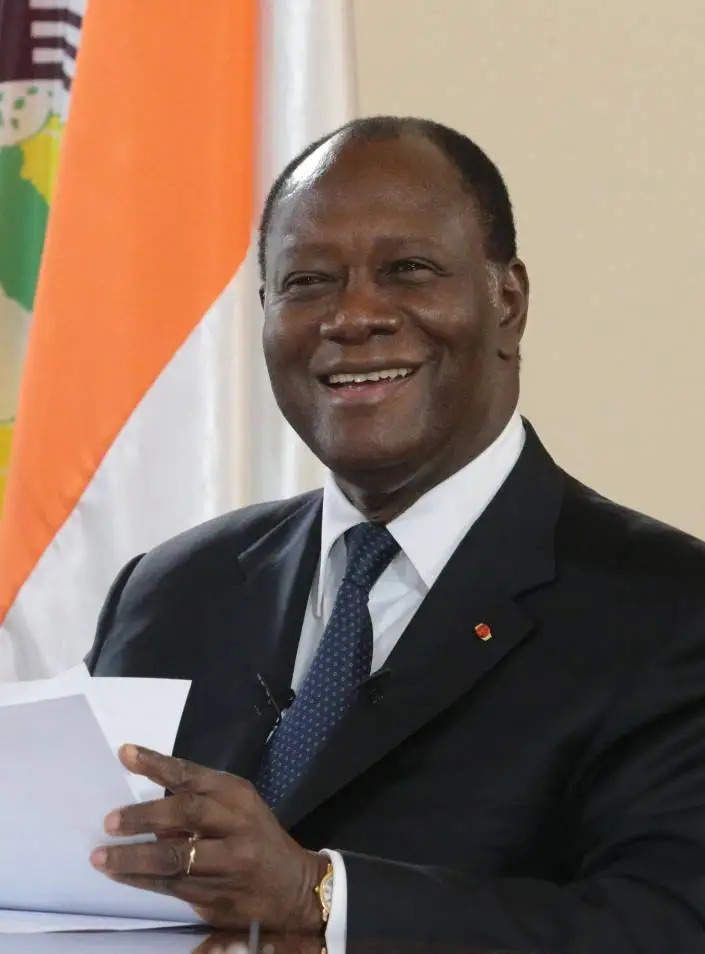
ABIDJAN, Ivory Coast, October 29th –President Alassane Ouattara has been declared the winner in the Ivory Coast’s presidential elections.
The country’s Independent Electoral Commission announced on Monday that the 83-year-old sitting head of state had won a fourth term with 89.77 percent of the ballots cast.
Nearly nine million Ivorians were eligible to vote on Saturday in a race that barred Ouattara’s top rivals. Former head of state Laurent Gbagbo was barred over a criminal conviction, while former Credit Suisse CEO Tidjane Thiam was disqualified from acquiring French citizenship.
The remaining four candidates were not seen as viable contenders, as they lacked backing from a major political party and significant financial resources. One of them, former Commerce Minister Jean-Louis Billon, who had congratulated Ouattara on Sunday, received 3.09 percent of the vote, while former First Lady Simone Gbagbo received 2.42 percent, according to the results read on state television by Ibrahime Coulibaly-Kuibiert, president of the electoral commission.
Coulibaly-Kuibiert put turnout at around 50 percent – a level comparable to the presidential elections in 2010 and 2015, but far below the 80 percent who voted in the first round in 2010.
Ouattara’s opponents accuse him of taking the country down an authoritarian path in which he chooses his electoral opponents. In the weeks leading up to the election, sporadic protests had broken out in response to the ban on key contenders from the polls, prompting the government to ban demonstrations and arrest more than 200 people from the campaign group- the Common Front.
Ouattara, who had a long career at the International Monetary Fund and Central Bank of West African States before becoming prime minister in 1990, has pointed to how much the economy has improved under his leadership, with increased foreign investment and transformed infrastructure and stability.
Ouattara’s campaign was heavily focused on security at a time of rising regional instability.
He enters his fourth term as violence threatens to spill over from Sahel neighbours Mali and Burkina Faso, where armed groups such as Jama’at Nusrat al-Islam wal-Muslimin (JNIM) and the ISIL affiliate in the Greater Sahara (ISGS) have been conducting a violent rampage.
Ouattara’s government, since 2022, has boosted the defence budget, increased troop deployments in the northern regions neighbouring the Sahel, and bought armoured tanks from countries like China.
As internal instability mounts, he has vowed to facilitate a passing of the torch to a new generation of political leaders. There is no clear successor at the moment, and the ruling party is riven with division.