For decades, a huge number of Persons with Disabilities (PWDs) have continued to experience unemployment, due to the ever-rising discriminatory practices and attitudes in the workplace.
According to the University of Nairobi (UoN)on Digital Repository, PWDs account for about 2.8 percent (918,270) of Kenya’s population (2019 census).
In 2021, the International Labour Organization (ILO) estimates put the unemployment rate among PWDs in Kenya at 7.6 percent, compared to the overall unemployment rate of 5.7 percent.
A further 80 percent represent unemployed adults who are PWDs out of the total population.
However, this has been attributed to multiple barriers to accessing quality education and vocational training.
PWDs also encounter limited access to mobility and assistive devices and vital support services, and social exclusion.
In a concerted effort aimed at addressing these anomalies, on Thursday, May 8th, President William Ruto assented to the PWD’s Bill 2025 into law.
The bill was sponsored by Senator Crystal Asige, and it replaces the current PWDs Act, Cap.133 of 2003. It aims at enhancing the rights, inclusion, and protection of people with disabilities.
“The new law guarantees ease of access to education, employment, and healthcare, inclusive, more accessible, and adaptable public spaces. It spells out defined roles for both tiers of government -national and county. This will ensure they are free from discrimination in all spheres of life.”
Other key milestones include the provision of financial incentives and penalties for the violation of persons with disabilities.
To unlock job opportunities in both public and private workplaces, the new law stipulates that there must be a mandatory 5 percent Disability Inclusion by the employers.
To fast track its sensitization and implementations, ILO in collaboration with UNICEF, UNFPA, the Ministry of Labour, and its affiliate Federation of Kenya Employers (FKE)-Western Region, organized a forum in the lakeside city of Kisumu.
ILO National Programme Coordinator, Dr Hellen Magutu Amakobe, said that they have unveiled a two-year program funded by the Global Disability Fund to ensure consistence strengthening in terms of policy and systemic levels of work.
“Through concerted efforts with stakeholders, disability inclusive workplaces, employment, and services will be attained. We will strive to achieve the 5 percent mainstreaming and provide services broadly in the sector by collaborating with all stakeholders to serve PWDs,” she said.
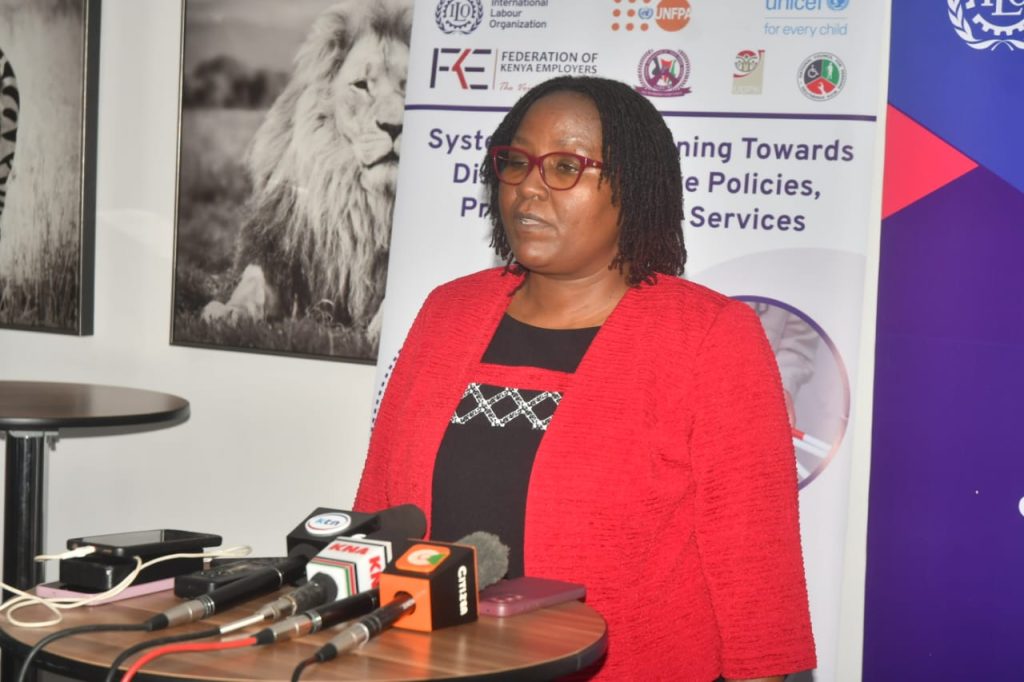
She pointed out that th iiis is borne out of the fact that Kenya registered 1 percent of PWDs in workplaces as the 2003 Act hasn’t been attained so far.
The National Council of Persons with Disabilities (NCPWD), Department of Disability Inclusion Officer, Steve Mugambi, said that under the new law, the state corporation has been restructured, given more functions and powers.
“Given the Employment Status Report on PWDs in Kenya, it will be an issue of performance to ensure that all public and private sectors employments are held accountable to PWDs,” he said.
According to Mugambi, the Public Service has 1.8 percent of PWDs employed-which is a huge gap.
In line with the foregoing, NCPWDs will on Wednesday ,28th May, hold a roundtable engagement with the government, the private sector (KEPSA), FKE, and other stakeholders to effect the new changes in their employment policies.
FKE Officer-in-Charge of Western region, Thomas Achok, said that Disability Inclusion is key to the organization as it will promote fair labour practices.
“We believe in the principle of walking together and leaving no one behind in collaboration with other key stakeholders. Our messaging is on inclusion and trying to accommodate PWDs in workplaces devoid of discrimination,” he stated.
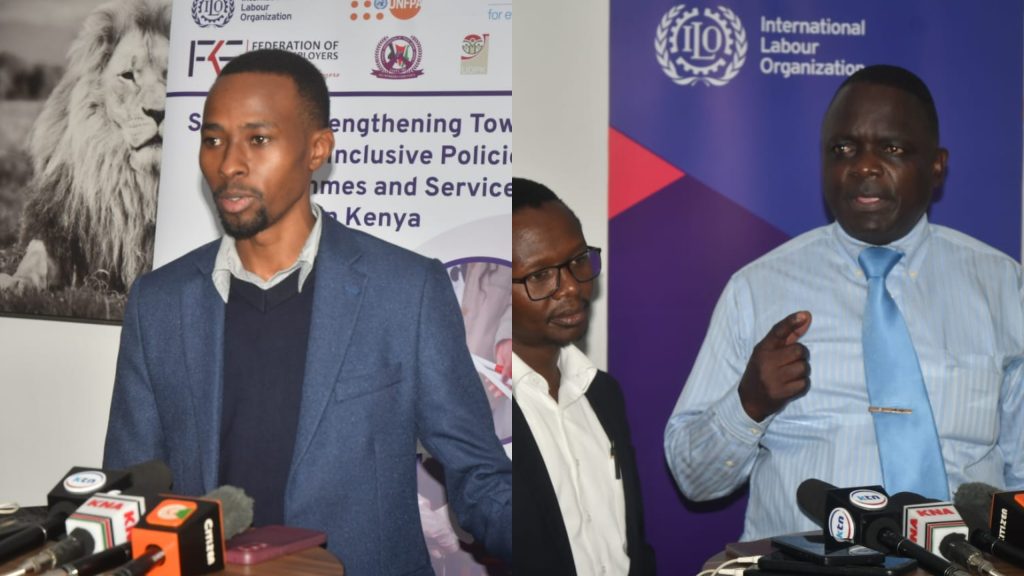
His position was affirmed by his counterpart, Dancun Omondi, who said that FKE has a purpose vehicle named Kenya Disabilities Networks (KDN).
“It brings employers together to promote matters of Disability Inclusion at workplaces. Our role also includes sensitizing employers and capacity building them to behave and appreciate the need to have PWDs in their fold.”
FKE will be laser-focused on sensitizing the employers on the new law, keenly look at the structures and systems of the employers, and assist in Skills Development among the PWDs.
“The general population is struggling with the Skills Mismatch in the labour market,” Omondi remarked.
It will be at the forefront of strengthening processes to ensure that the School-to-Work Transition is smooth.
“We will ensure that PWDs will get more internships, industrial placements, and mentorships to uphold adherence to the new law,” FKE stated.