NAIROBI, 2 September 2026 – Breaching the 1.5°C global warming limit is now unavoidable in the coming years, but the world can still curb how high and how long temperatures exceed it and work to bring them back down, the UN Environment Programme (UNEP) says in a new report.
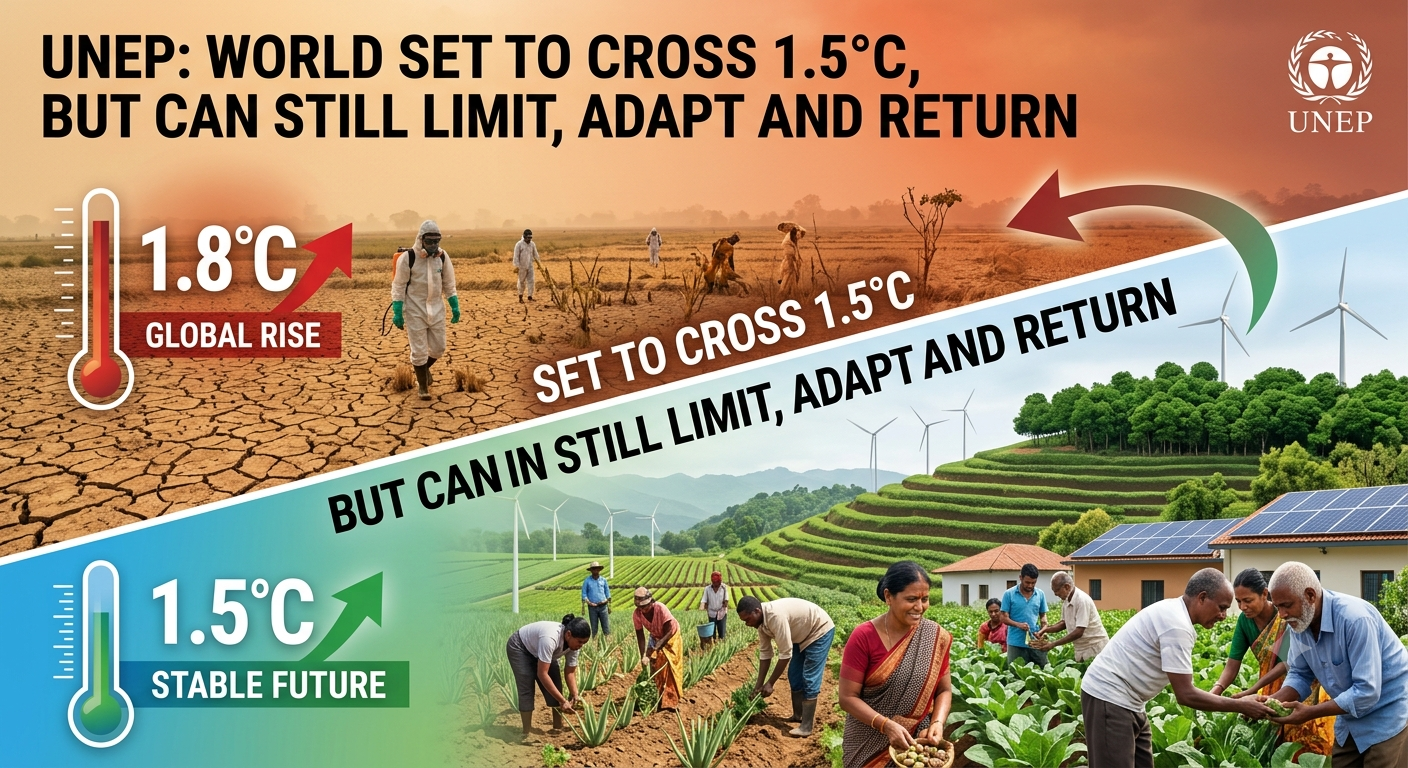
In the report titled Limiting Overshoot, launched in Nairobi today, UNEP projects that even under the most optimistic pathway, global temperatures will peak at around 1.8°C above pre-industrial levels. Other modelled pathways point to peaks well beyond 2°C.
The findings signal a shift from the original Paris Agreement ambition of holding warming to 1.5°C, towards what UNEP calls an “overshoot, peak and decline” trajectory – aimed at keeping the exceedance as limited and as brief as possible and returning below 1.5°C at the earliest opportunity.
UN Secretary-General Antonio Guterres said the extreme weather seen this year should serve as a warning.
“This summer’s scorching heat, raging wildfires and deadly floods are a warning of what lies ahead. We must make the overshoot above 1.5 degrees as small and short as possible. That demands an overshoot of ambition,” Guterres said.
What it will take
According to UNEP, achieving that trajectory will require immediate, deep and sustained reductions in greenhouse gases, including methane, on the path to net-zero, and eventually moving to net-negative emissions where more carbon is removed than emitted.
Carbon Dioxide Removal (CDR), which involves capturing carbon from the atmosphere and storing it through methods such as afforestation and other technologies, will be essential but must be carefully governed, the report says.
Alongside mitigation, countries must scale up adaptation to reduce vulnerability to both current and future climate shocks. UNEP cautions, however, that adaptation has limits, and some losses will be irreversible if the peak temperature is not kept as low as possible.
“There are no good outcomes if we remain above 1.5°C. Across the globe, extreme heatwaves are already proving that climate impacts will strike faster, hit harder, and last longer – costing more lives and causing deeper disruption,” said UNEP Executive Director Inger Andersen.
“Now is the time we must double down on climate action. We can – and must – get on the right path. By cutting greenhouse gas emissions, strengthening resilience and adaptation, and ensuring exceedance of 1.5°C is as small and short as possible,” Andersen said.
Risks of staying above 1.5°C
UNEP warns that every fraction of a degree beyond 1.5°C amplifies climate risks and increases the chance of crossing irreversible tipping points.
The report lists more intense extreme weather events, loss of ecosystems, and the inundation of Small Island Developing States and low-lying coastal cities among the expected consequences. It also points to serious threats to public health, food production, water security, biodiversity, urban systems, infrastructure and economic stability.
Key tipping points highlighted include the destabilization of major ice sheets, dieback of the Amazon rainforest, and disruption of the Atlantic Meridional Overturning Circulation (AMOC), the ocean current system that helps regulate global climate by transporting warm surface water northward and cold deep water southward. Some changes could occur abruptly, others gradually.
The report notes that shifting rapidly from fossil fuels to renewable energy would bring co-benefits, including cleaner air, improved public health, reduced energy costs and expanded access to electricity.
Enabling conditions
UNEP says success will depend on strong political will, multilateral cooperation, effective policymaking, inclusive governance and adequate finance. It stresses that equity and justice must be central to all responses, with countries that have contributed most to climate change expected to act with greater speed and ambition.
Mitigation and adaptation should progress in tandem and reinforce each other, the report says, with priority given to interventions that deliver both, such as nature-based cooling solutions.
Adaptation measures put in place now will lay the groundwork for the future, but they must become more transformational and able to respond to non-linear and sudden risks, including those that could undermine mitigation efforts.
On CDR, UNEP states that net-zero should be viewed as a step towards net-negative. Removal technologies can only credibly help return warming to below 1.5°C if the peak remains well under 2°C and residual emissions are drastically cut. Robust governance will be needed to ensure environmental integrity, fairness and scalability.
A changed future
Even if temperatures are brought back below 1.5°C, some losses and permanent changes to living conditions are now inevitable after years of delayed action, according to UNEP.
This could mean communities having to relocate or adopt new livelihoods, raising complex questions around justice, power and political legitimacy that will demand inclusive governance frameworks.
UNEP describes the overshoot, peak and decline pathway as a new climate frontier, but warns it cannot be deferred to future generations.
Ahead of the next UN climate summit, leaders said the report should spur action.
“Every fraction of a degree of warming above 1.5 leads to increasing and increasingly severe climate impacts, with our Pacific family standing on the frontlines. While we know the challenge is growing, so too is momentum,” said Chris Bowen, Australia’s Minister for Climate Change and Energy and President of Negotiations for COP31.
“COP31 is an opportunity to turn our ambition into action — with Turkey, Australia and the Pacific delivering a practical, solutions-focused COP,” Bowen said.
COP31 President-Designate H.E. Murat Kurum said exceeding 1.5°C must not be treated as a new normal.
“Every fraction of a degree matters, and every year spent in overshoot increases climate risks and the potential for irreversible losses. The Overshoot Report makes clear that exceeding 1.5°C should not be seen as a new destination, but as a pathway we must urgently work to minimize and reverse,” Kurum said.
“This requires rapid and sustained emissions reductions, alongside ambitious adaptation to protect people, communities and ecosystems. COP31 must turn this urgency into concrete action. We need to accelerate global electrification, reduce methane emissions from waste, strengthen the climate resilience of cities, and enhance the resilience of marine and coastal ecosystems,” he added.
For vulnerable regions such as the Lake Victoria basin, the report underscores that adaptation is no longer optional, with local resilience, sustainable fisheries and diversified livelihoods likely to determine how communities experience the overshoot period. (AI-Generated Image)