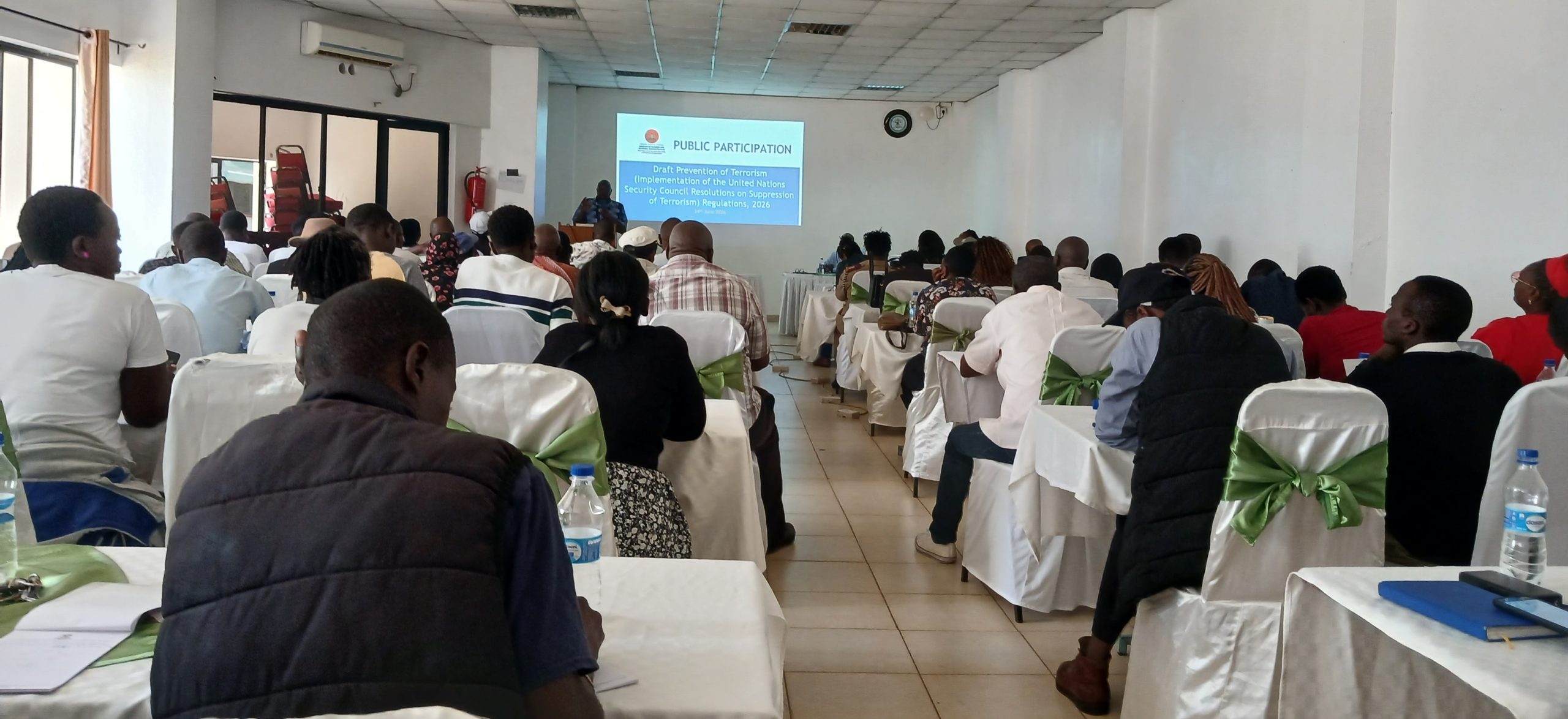
Kisumu, June 2026 –Calls to address terrorism financing, historical injustices, marginalisation and unequal resource distribution dominated a public participation forum on the Draft Prevention of Terrorism (Implementation of UN Security Council Resolutions on Suppression) Regulations 2026 held in Kisumu on Wednesday. Stakeholders warned that security operations alone cannot defeat violent extremism.
The forum, convened by the Ministry of Interior and National Administration, sought public views on the draft regulations that aim to align Kenya’s domestic laws with international best practice on combating terrorism and terrorism financing. The regulations are anchored on United Nations Security Council Resolutions 1267 and 1373, which require member states to take action against individuals and organisations linked to terrorism.
In Kenya, the implementation process is overseen by the Counter-Financing of Terrorism Inter-Ministerial Committee, chaired by the Cabinet Secretary for Interior and comprising senior officials from key security and financial institutions, including the Central Bank of Kenya.
Root causes
Stakeholders urged the government to adopt a holistic approach that tackles the root causes of terrorism. Speakers emphasised continuous community engagement, strengthened devolution and equitable development alongside law enforcement measures in the final draft.
Failure to address long-standing grievances, especially among young people, risks leaving many vulnerable to recruitment by extremist groups despite strict security laws.
Willis Otiende, a resident from Manyatta, said terrorism should be viewed as a symptom of deeper societal problems rather than an isolated security issue.
“Terrorism is like an iceberg. What we see are the attacks, but beneath the surface are issues of unemployment, marginalisation, historical injustices and lack of opportunities that must be addressed if we are serious about prevention,” Otiende said.
He added that with nearly 70 percent of Kenya’s population comprising young people, the government must invest more in programmes that create jobs and economic opportunities. Many youths remain vulnerable to radicalisation because of limited access to employment and skills development, making them easy targets for criminal networks.
Caleb Danga of Opinion Shapers noted early indicators of extremism, including goonism, that create an environment for terrorism to thrive. “We are the fertiliser that creates an environment for terrorism to thrive, and stigmatisation of certain communities,” he said.
Financial networks
James Manyonge of the Financial Reporting Centre (FRC) told participants that while governments often focus on pursuing terrorists on the ground, targeting financial networks remains one of the most effective ways of combating terrorism.
“Wananchi should be watchful and alive to what is taking place around them. Terror financing can even come from sympathisers,” Manyonge cautioned.
He clarified that the draft does not target any community and is intended to strengthen Kenya’s framework for preventing terrorism and violent extremism through legal, institutional and community-based interventions.
“Each terrorist activity has people behind it who finance it. These regulations are aimed at dealing with the people involved in terrorism financing,” he said.
Asset freezing
Manyonge explained that the regulations provide mechanisms for designating individuals suspected of financing terrorism, freezing their assets without delay, and preventing funds from reaching terrorist organisations.
“What the regulations do is provide for asset freezing. Where funds and assets have been identified, those assets should be frozen immediately so that the funds are not made available to terrorist organisations,” he said.
He emphasised that members of the public have a critical role in identifying and reporting designated individuals, noting that those involved in financing terrorism often live within communities unnoticed.
“The people involved in financing live among us. They are our brothers, sisters, relatives, friends and neighbours. Members of the public have an obligation to identify these people, freeze their funds where applicable, and report them so authorities can take action,” he stated.
In line with UN Resolution 1373, the committee has designated 13 persons as sponsors of terrorism. Residents were taken through procedures for seizing property, freezing bank accounts and delisting a designated person when circumstances change.
Mr Thaddayo, Opinion Shapers Group representative for Persons with Disability, argued that the 24-hour period set for freezing accounts was too short and should be adjusted to 48 hours, with others suggesting three days.
In response, Manyonge reiterated that delays were not an option. “The requirement is to deal with it without delay. Every second counts, and if you delay by even a minute, then those funds are going to leave into other people’s hands,” he said.
Community policing
Although Kisumu has not experienced terrorism incidents, residents were briefed on major historical attacks in Kenya, including the 1980 bombing of the Jewish-owned Norfolk Hotel in Nairobi that killed 20 people; the 1998 US Embassy bombing that killed about 250 and injured over 5,000; the 2002 Paradise Hotel attack in Mombasa and attempted missile strike on an Arkia Airlines flight that killed 13 and injured 80.
In 2013,there was the Westgate Mall attack that killed 67; the 2015 Garissa University attack that killed 148; and the 2019 DusitD2 attack that killed 21.
This, stakeholders said, calls for strengthened community policing structures and local security committees to facilitate early detection of threats and improve cooperation between residents and law enforcement agencies.
Attendees also recommended increased investment in vocational training, entrepreneurship support, school retention initiatives and livelihood programmes aimed at reducing economic vulnerability among at-risk populations.
Rights protection
Concerns were raised regarding the protection of individual rights and the possibility of wrongful designation. Manyonge assured participants that the regulations contain provisions allowing affected persons to seek legal redress.
“A lot of issues have been raised about the rights of individuals. The regulations are wide and they also provide avenues for people caught up in the process to seek redress,” he explained.
Participants also noted Kenya’s placement on the international grey list over deficiencies in its anti-money laundering and counter-terrorism financing framework. Manyonge said the proposed regulations form part of reforms required for the country to align with international standards and strengthen financial oversight.
“The government needs to put these regulations in place to address the issue of grey listing. We have found that our framework to combat money laundering and terrorism financing is not fully in line with international standards,” he said.
He added that the level of understanding demonstrated by participants on such technical matters reflected a highly informed public.
Stakeholders maintained that sustainable prevention of terrorism would only be achieved through a combination of effective regulations, inclusive governance, community ownership and long-term socio-economic development.