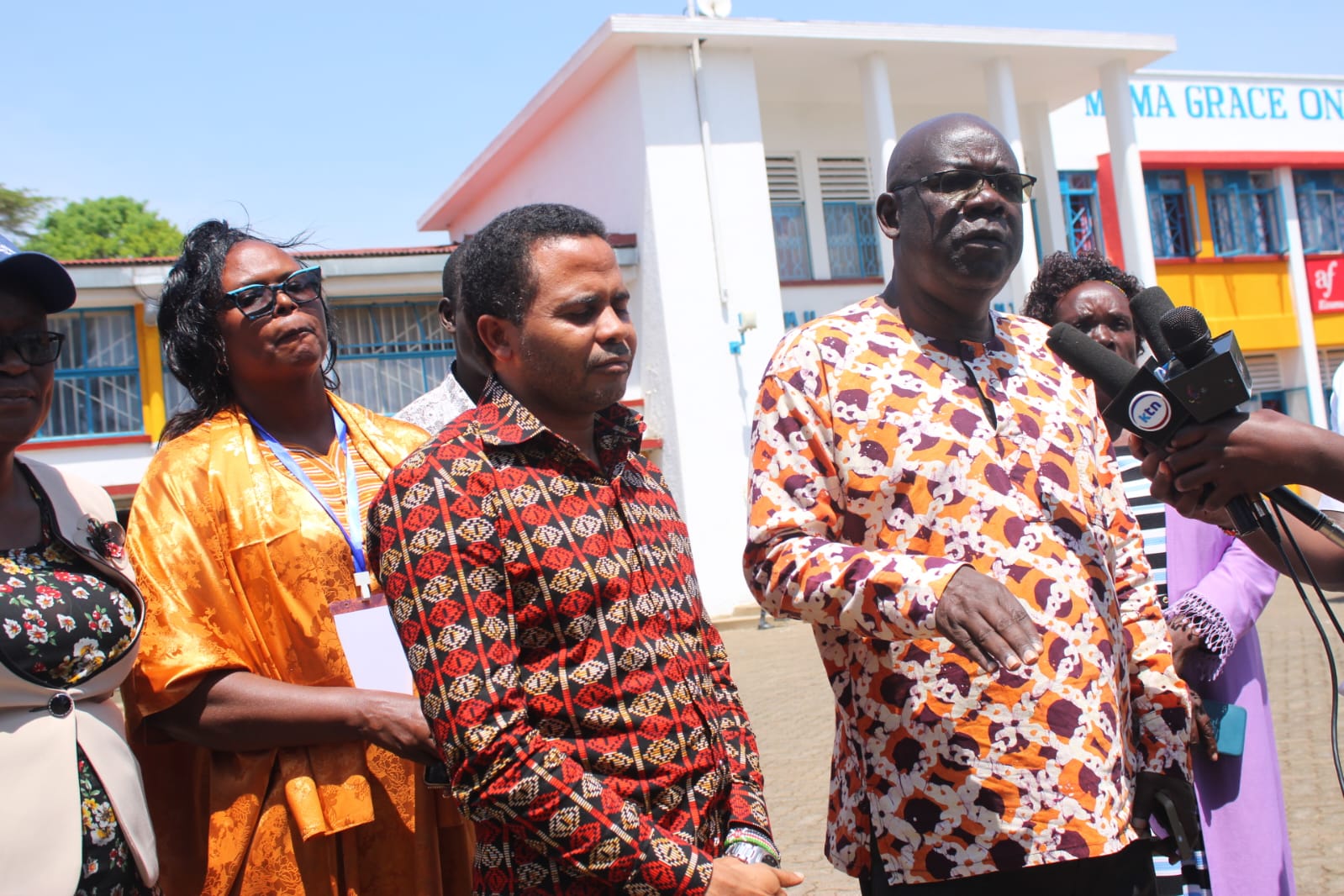
For the safety of the school heads interviewed, their names have been concealed due to fear of reprisals from officials within the Ministry of Education
KISUMU, Kenya –For more than a decade, the education landscape in the Nyanza region has been shaped by a figure whose voice has often thundered where many whispered.
Innocent Masara, the director of the Track One Learners Alliance, remains a name spoken with equal parts admiration and apprehension among teachers, administrators, and education officials.
His activism, often bold, sometimes controversial, won him the respect of school principals who say he stood with them at a time “no one else dared to.”
Masara, a Kenyan public figure known for education advocacy and political involvement, rose to prominence by challenging directives and practices he argued violated both the constitution and the rights of teachers and students.
In a region grappling with entrenched bureaucracy, alleged corruption, and arbitrary decision-making, Masara distinguished himself as a defender of school heads frequently targeted by administrative high-handedness.

In one sub-county, a principal recalls the tense months when school heads faced abrupt transfers, often without explanation.
“Those were painful days,” the principal says. “We were living in fear. You would wake up, find a letter on your desk, and by afternoon, you were expected to report hundreds of kilometres away without any hearing or justification. Masara challenged that impunity. He told the officials, openly, that principals were not pawns. We felt protected for the first time.”
Masara’s fight against arbitrary transfers earned him widespread admiration.
Through the Track One Learners Alliance, the organisation he leads to advocate for education reforms and legal interventions, he pushed back against what he called “procedural shortcuts that end up punishing hardworking educators.”
Teachers, long weary of punitive postings and opaque disciplinary processes, embraced him as a rare champion.
According to another principal from Kisumu County, Masara’s confrontations with education officials changed the tenor of regional leadership.
“Before Masara stepped in, you wouldn’t question any directive,” the principal recalls.
“Even if it was harmful to the school, you simply obeyed. He stepped into meetings and said things we wished we could say. He confronted senior officers who acted like principals were disposable. That courage inspired us.”
But his outspoken stance came at a price. Education officials were reportedly unsettled by his assertiveness, and his insistence on due process often put him at odds with policy enforcers who expected quiet compliance.
“He shook the system,” the principal adds. “You could see that some officials felt threatened by his fearlessness. But teachers felt seen.”
Opposition to School Mergers
One of Masara’s most publicised stands involved rejecting the government directive to merge primary and secondary schools.
Speaking on behalf of his Alliance, he criticised the move as rushed, legally questionable, and lacking consultation with teachers, parents, boards of management, and civil society.
In Siaya County, one principal says Masara articulated concerns school leaders had quietly harboured.
“We knew the merger decision had not considered realities on the ground,” the principal says. “Schools are not just names on documents; they are communities with histories, boards, and support systems. When Masara opposed the merger, he did so because the process ignored the very people running the schools. He spoke our truth.”
Masara consistently argued that reforms must uphold institutional autonomy and align with constitutional requirements. To many, this positioned him as an essential counter-voice in a sector where major decisions often appear top-down.
“He didn’t oppose reform,” the principal adds. “He opposed blind reform.”
A Tense Relationship With Regional Politics
Masara’s political career added complexity to his public persona. He ran as an independent candidate in the 2020 Homa Bay Senate by-election and previously vied for Speaker of the Homa Bay County Assembly. His political independence put him at odds with ODM, the dominant party in the region.
A principal from Migori County says his firm’s positions on justice and integrity often clashed with political interests.
“He was not the type you could intimidate or lure with promises,” the principal explains. “If he believed something was wrong, no party loyalty could make him keep quiet. That made him admirable to educators, though inconvenient to politicians.”

The principal adds that Masara frequently rejected overtures from senior education officials seeking to soften his stance.
“He would tell us, ‘If I compromise on your rights, then why am I here?’ That consistency strengthened our trust in him.”
A Symbol of Resistance in a Troubled Sector
Beyond specific disputes, Masara’s influence is measured in the confidence he gave school heads who felt isolated.
Principals across Nyanza describe a sector plagued by nepotism, corruption, and rivalries that left educators vulnerable.
“Many played it safe because they feared losing their jobs,” one principal says. “Masara was different. He wasn’t looking for favours. He wasn’t afraid of career consequences. He stood for truth and justice even when it made him unpopular.”
His activism inspired a culture of resistance, encouraging school heads to demand fairness and speak up against malpractice.
“He reminded us that integrity is not negotiable,” the principal adds. “Even if you are alone, hold your ground.”
Legacy Still Felt
Though Masara’s methods and statements sparked debate, his impact on Nyanza’s education sector remains widely acknowledged.
Principals interviewed describe him as a figure whose firm stance reshaped relations between school heads and authorities.
“Whether you agreed with him or not,” one principal says, “you could not deny that he changed things.”

Another principal summarises his legacy simply: “He gave teachers courage. And sometimes, that’s all we need.”
As Nyanza continues to navigate reforms and shifting policies, educators say the spirit embodied by Innocent Masara, fearless, principled, and unapologetically vocal, remains a crucial reminder that the fight for fairness in schools is far from over.