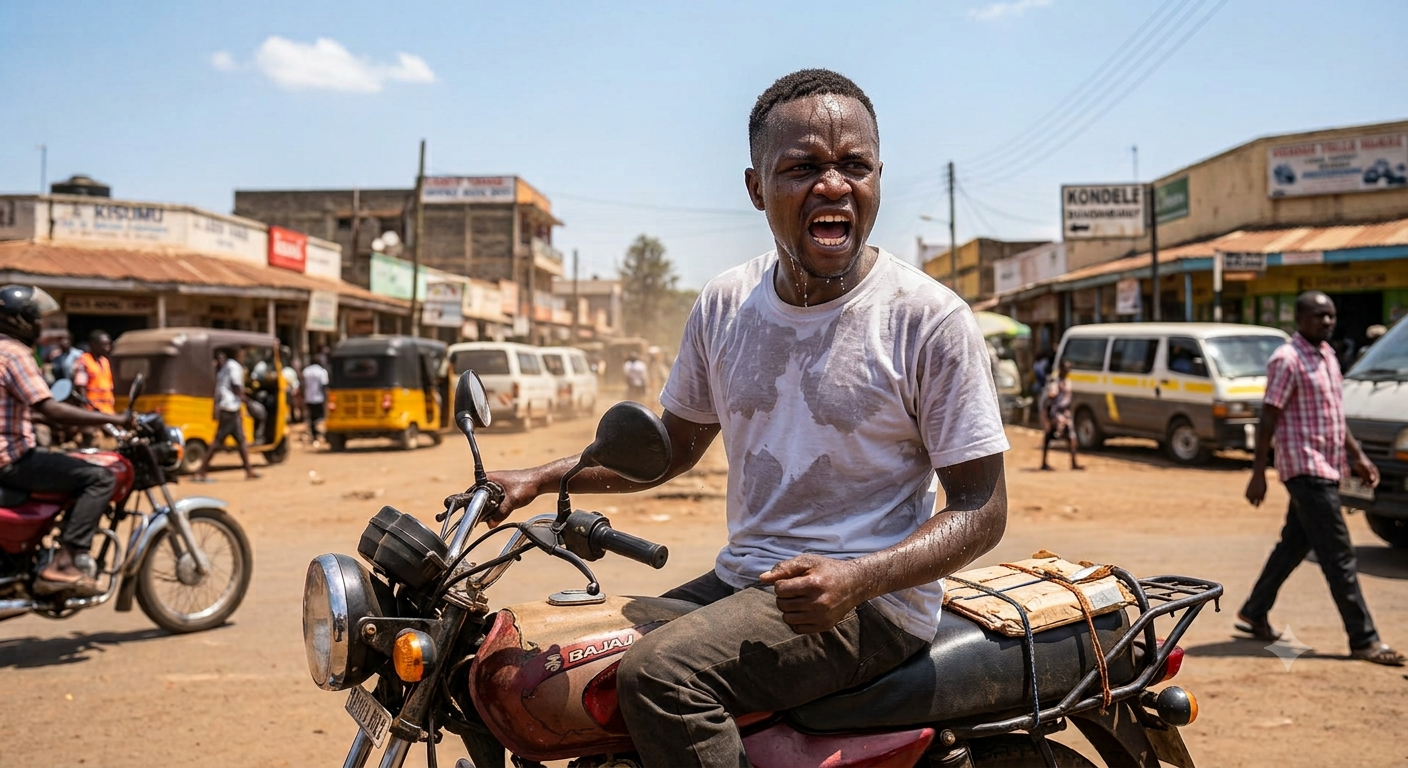
Photo Credit: Generated by AI for illustration purposes only.
At 1:20 pm in the heart of Kisumu’s Central Business District, Onyango Otieno, 35, commonly known as Jaboda, sits uncomfortably on his boda boda (motorbike taxi) at his designated base.
Caught between the scorching sun and the desperate hope of getting his next customer to feed his family.
Around him, matatus hoot non-stop, and clothes vendors call out to passersby, most of them shielding themselves with hats, sunglasses, and headgear.
Jaboda finds no such relief. Sweat rolls down his face and soaks his white T-shirt as he stares into the still horizon for a break that feels “elusive.” The temperature is estimated at over 37°C.
“Of late, I have been drinking a lot of water. Since I can’t afford to buy bottled water from retail shops, I usually ask for water at food joints. Even the food joint owners sometimes get concerned about how often I ask for more water. The temperature is high, unlike in past seasons,” he says as his eyes dart across the busy street, searching for his next client.
A few metres away at the Kisumu Bus Terminus, Mama Jane Atieno faces the same predicament.
Her years-old, donated orange umbrella offers almost no shade and seems to be crying for mercy. Dust blows all day, and gas emissions from matatus crowd the air, a sign of a constant hazard.The conditions have taken a toll on her health and on her business. Without adequate cold storage, her fruit spoils quickly.
“Health-wise, it is taking a toll on my body, and most of my recent oranges and mangoes have rotten because of the level of temperature and low purchasing power,” she says as she packs a few for a customer. “That’s my first sale since morning.”
Twenty-five kilometres away in Ahero, rice farmer John Midika surveys his plantation with anguish. Much of the crop has withered this season, leaving the fields looking dry and unhealthy and raising fears of a poor harvest.
With the rains yet to return, Midika is staring at the prospect of significant losses.The prolonged dry spell has left little hope for a bumper harvest, with farmers now depending on the return of rainfall to salvage what remains of their crops.
Their experiences reflect a growing global crisis. Heat waves are becoming more frequent and severe as the planet warms.
The World Health Organization (WHO) describes heat waves as a period where excess heat accumulates over a sequence of unusually hot days and nights.
“Even low and moderate intensity heatwaves can impact the health and wellbeing of vulnerable populations,” WHO warns. “The frequency and intensity of extreme heat and heat waves will continue to rise in the 21st century because of climate change. Extended periods of high day and nighttime temperatures create cumulative stress on the human body, increasing the risk of illness and death from heat exposure.”
Locally, the Kenya Meteorological Department defines a heat wave as three or more consecutive days of extremely high daytime temperatures exceeding local health-risk thresholds. For Kisumu, a heat
wave is triggered when daily maximum temperatures reach 37°C or higher for at least three consecutive days. Nairobi and Mombasa thresholds are 32°C and 36°C, respectively, for the same period.
According to the meteorological body, the thresholds are tied directly to local historical data and to a rise in hospital admissions and mortality risks. When limits are exceeded, public health alerts are activated to protect children, the elderly, and people with pre-existing conditions.
The department clarifies that short-term spikes in temperature are part of standard warm seasons unless they meet the multiday criteria.
“Human activities have contributed to the emergence and intensification of climate related hazards. We have witnessed floods, droughts and now increasingly severe heat waves, all of which are posing growing risks to public health,” says Rose Mokaya, Assistant Director of Public Health at Kenya’s Ministry of Health.
According to WHO, heat waves are a leading environmental and occupational health hazard. Heat stress is a leading cause of weather-related deaths and can worsen cardiovascular disease, diabetes, mental health conditions and asthma. It can also increase the risk of accidents and the transmission of some infectious diseases.
The bad thing is that heat waves can affect large populations in a short time, trigger public health emergencies and result in excess mortality and cascading socioeconomic impacts such as lost work capacity and labor productivity. They can also disrupt health facilities, transport, and water infrastructure.
The number of people exposed to extreme heat is also growing exponentially due to climate change in all world regions, according to the global body’s reports.
Heat-related mortality for people over 65 years increased by approximately 85 percent between 2000–2004 and 2017–2021.
Between 2000 and 2019, studies show approximately 489,000 heat-related deaths occurred each year, with 45 percent in Asia and 36 per cent in Europe.
“Climate change is no longer a distant threat; it’s a health crisis happening in our wards today,” Mokaya said during a virtual Media Science Café organized by Media for Environment, Science, Health and Agriculture (MESHA) while presenting on the topic “The Nexus between Climate Change and Health: Building Climate-Resilient and Sustainable Health Systems in Kenya.”
According to Mokaya, though Kenya doesn’t experience a lot of heat waves, the health effects of heat waves are already being felt. In Turkana and Baringo counties, increasing heat waves have been linked to more cases of dehydration and kidney problems, according to the Ministry of Health.
The bad thing, according to her, is that the burden of extreme heat is not evenly distributed. Pregnant women, young children, older people, the urban poor and pastoralist communities are among those most affected by heat waves.
“We don’t experience a lot of heat waves in the country, but when you hear stories from other countries, you realise it is a serious issue. You really feel that something needs to be done,” she concluded.
This story was first published in Sayansi magazine, a monthly publication by Media for Environment, Science, Health and Agriculture (MESHA).