The Ministry of Education is facing strong condemnation for its mishandling of three critical matters affecting the education sector.
Firstly, the improper disbursement of Sh22 billion as a capitation for term two to aid learners in all public schools.
Public schools’ management remains at a crossroads on how to adequately spend the ‘meagre amounts’ to offset the pending bills.
The selective deletion of students’ names from the National Education Management Information System (NEMIS) system after being uploaded by the teachers is a sticky concern.
This is coupled with the looming threat regarding the removal of hardship allowances for teachers serving in designated areas.
Moreover, the ongoing saga around teacher promotions continues to frustrate many, with those who were ‘successfully recruited’ expressing their grievances.
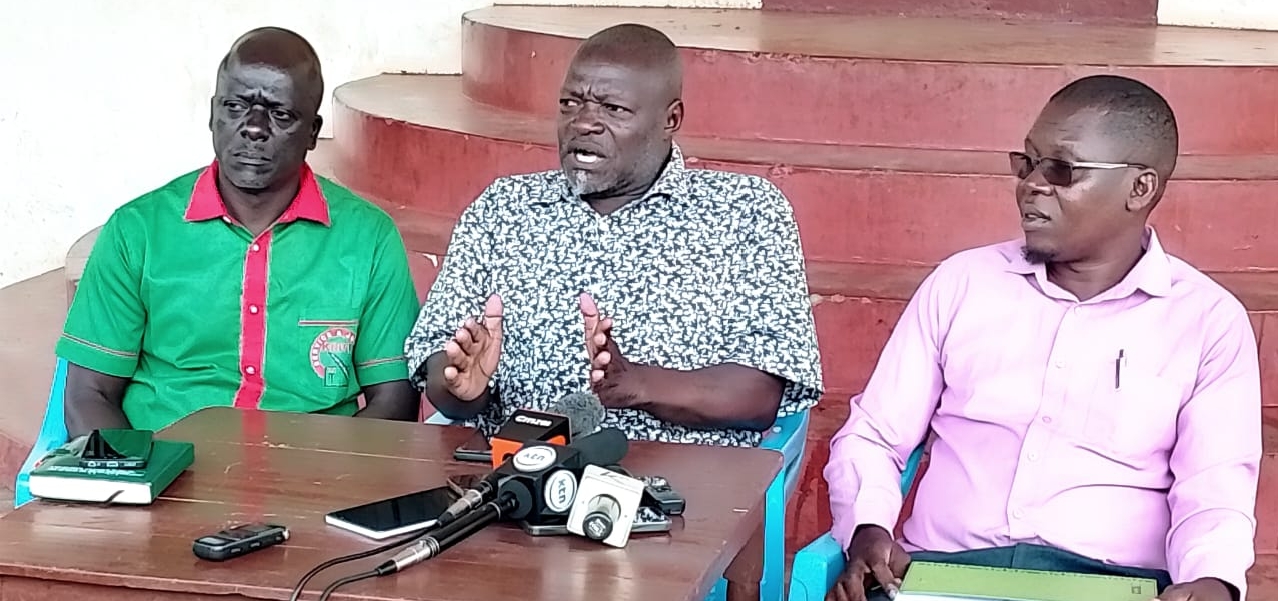
Leading the onslaught, officials from the Kenya National Union of Teachers (KNUT) in Kisumu County have described the process for distributing the Sh22 billion school capitation as shrouded in a lot of mystery.
“If school administrators are given Sh84, Sh2,000, and Sh4,000, how much is that supposed to cover for the students? The government needs to clarify whether they can truly fund free primary education, which is a right for every child,” they stated during a press conference held at Jaramogi Oginga Sports Ground -Kisumu yesterday.
The union officials were led by Knut Executive Secretary Kisumu West, Edward Olando, Knut Executive Secretary Nyanza Region, David Obuon, and Knut Executive Secretary Nyando Sub-County, Ephraim Kananga are demanding proper capitation rates and appropriate circulars for each student.
NEMIS
Mr Olando, who doubles up as the KNUT NEC Person with Disabilities (PWDs), expressed his displeasure at the continued intimidation headteachers face when trying to raise complaints.
Additionally, they voiced their concerns about the impending introduction of the Kenya Education Management Information System (KEMIS), which is set to replace the current NEMIS.
“Teachers remain a frustrated lot as the system always cherry-picks which students’ names remain in the system. The rest are marked red in less than a minute after uploading,” they said.
NEMIS is solely intended to collect, process and give statistical data on schools, students, and teachers’ performances.
On the other hand, KEMIS is used to gradually monitor the performance of learners and teachers from Early Childhood Development Education (ECDE) to Institutions of Higher Learning.
“It’s also used to efficiently and effectively manage education resources.”
How Sh22 Billion Was Distributed
On May 21st, Education Cabinet Secretary Julius Ogamba confirmed the release of Sh22,028,911,191.40 as a capitation for Term 2 for learners in all public schools.

According to CS Ogamba; Sh1.37 billion, Sh8.9 billion, Sh118 million and Sh11.6 billion were disbursed for Free Primary Education, Free Day Junior School Education, Junior School Special Needs Education, and Free Day Secondary Education respectively.
Quashed Teachers Promotion
The promotion of 25,252 teachers by the Teachers Service Commission (TSC) is facing headwinds from the National Assembly’s Committee on Education.
The union officials points out that this may lead to a steep rise in mental health cases
TSC conducted interviews in January and February, but the ‘promoted teachers’ celebrations were short-lived as the legislators have rejected the list.
The Tinderet MP Julius Melly-led committee is mulling over the kickstarting of a new promotion exercise.
They have cited; “several accusations of irregularities, skewed ethnic representations, and disregard to promotions criteria.”
Also in contestation is the promotion of 5,291 teachers who have worked for less than six months in their present job groups.
Hardship Allowances
The trio- Olando,Obuon and Kananga vehemently opposed the reduction of the number of designated hardship areas and allowances.
Its paid to teachers serving in remote, arid, and difficulty prone areas.
The hardship allowances, are legally secured through multiple Legal Notices and Collective Bargaining Agreements with the TSC.
“Our teachers serving in Nyando, and Muhoroni Subcounties continue to bear this brunt,” they said.
“As a people of this region, the only thing our children can rely on is education; unfortunately, they claim it is free, yet it is not,” the union officials concluded.