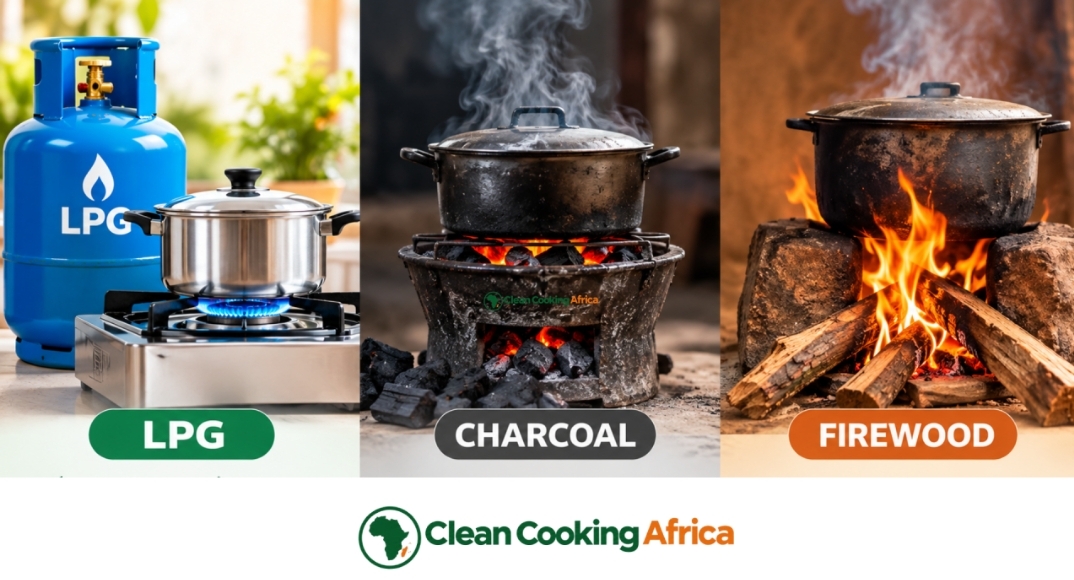
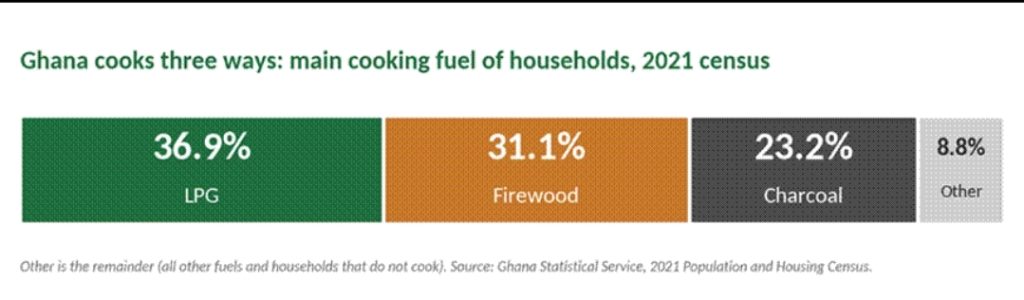
Open the 2021 Population and Housing Census of Ghana and you find a country that cooks three ways at once. LPG is the main fuel in 36.9 percent of households, firewood in 31.1 percent and charcoal in 23.2 percent (Ghana Statistical Service [GSS], 2021).
Households are rarely choosing between a good fuel and a bad one. They are weighing smoke, cost, convenience, safety and supply, and often using more than one fuel in the same week.
This Education Update compares the three fuels on those terms, drawing on measurements taken in African kitchens wherever they exist. On some questions the evidence points clearly in one direction. On others it stays honestly mixed, and we say so.
Who cooks with what
Fuel choice in sub-Saharan Africa follows the road from village to city. Rural households mostly burn firewood. Charcoal dominates in urban areas because it is easier to transport than wood (Rose et al., 2022). LPG is the main clean option: the IEA reports that it accounts for more than 70 percent of the people with access to clean cooking (IEA, 2026).
What the air in the kitchen shows
Cooking smoke is the strongest case against solid fuels. The World Health Organization (WHO) attributes about 2.9 million deaths a year to household air pollution, including more than 309,000 deaths of children under five (WHO, n.d.). The narrower question here is how different the three fuels look when someone actually measures the air.
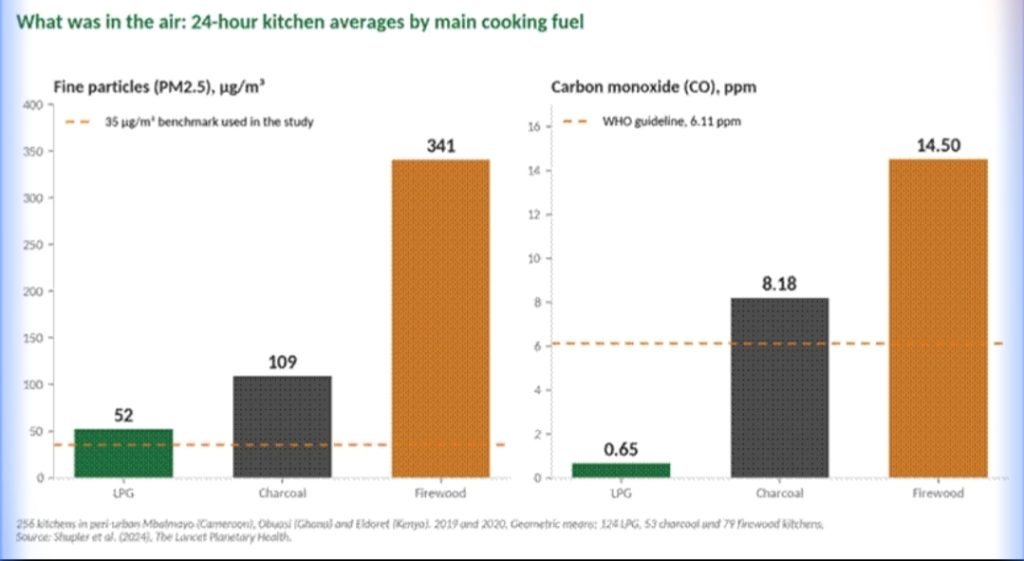
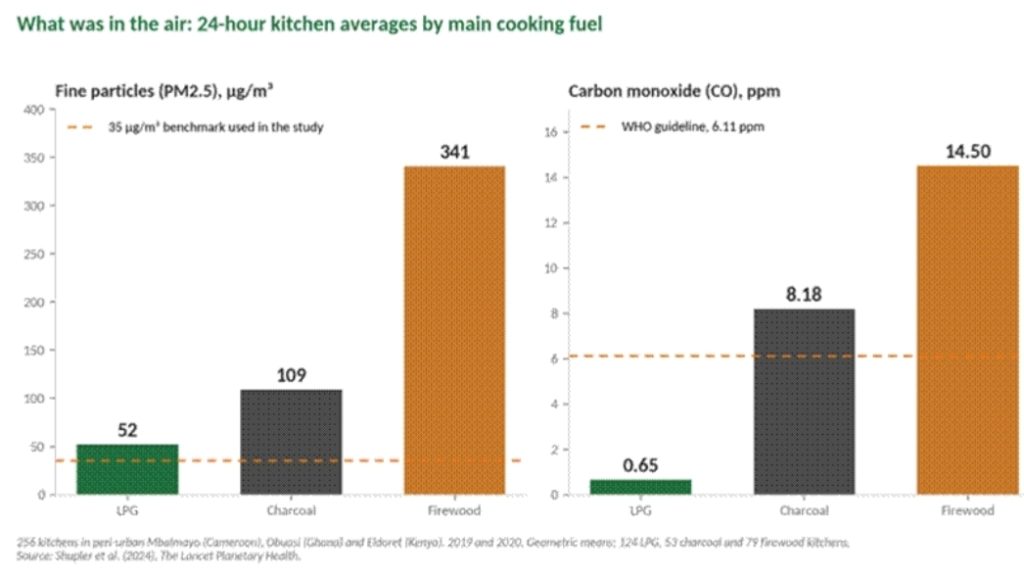
The CLEAN-Air(Africa) study did that. In 2019 and 2020, researchers monitored 24 hours of air quality in 256 kitchens across three peri-urban communities: Mbalmayo in Cameroon, Obuasi in Ghana and Eldoret in Kenya (Shupler et al., 2024). On average, kitchens where people cooked mainly with LPG recorded 52 micrograms of fine particles (PM2.5) per cubic metre of air. Charcoal kitchens averaged 109 and firewood kitchens 341. For carbon monoxide, the averages were 0.65 parts per million for LPG, 8.18 for charcoal and 14.50 for firewood, against a WHO guideline of 6.11 (Figure 2).
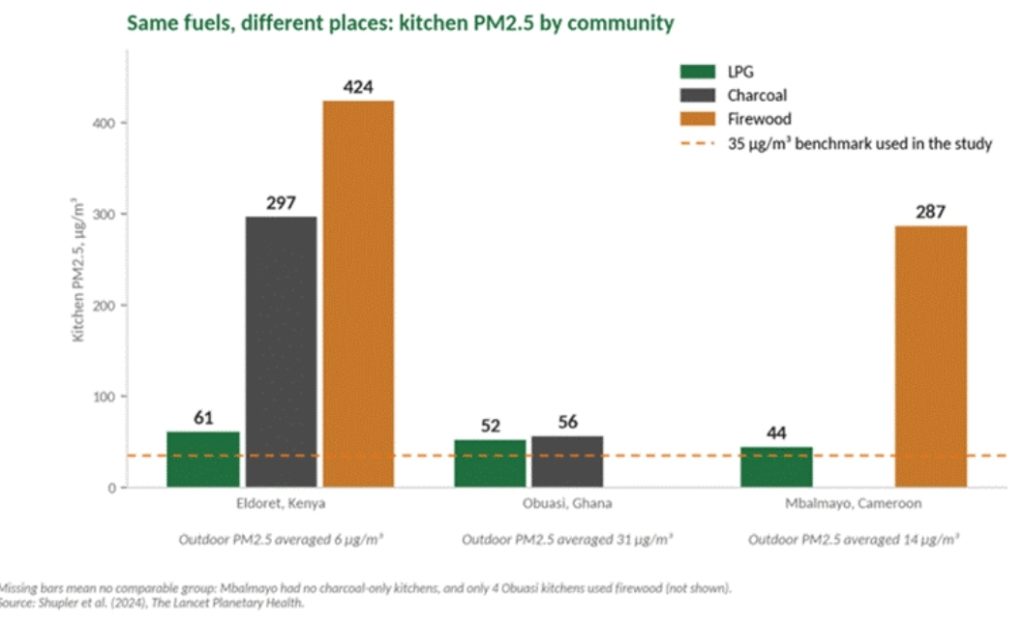
Two details keep this from being a simple story. First, LPG did not guarantee clean air. Even LPG kitchens averaged above the 35 micrograms per cubic metre benchmark the authors used, because outdoor pollution from traffic, rubbish burning and dust drifts indoors. Second, the gap between fuels depended on where the kitchen was. In Eldoret, charcoal kitchens averaged 297 micrograms against 61 for LPG. In Obuasi they averaged 56 against 52, almost no difference (Figure 3).
Outdoor air offers a likely explanation. Outdoor PM2.5 averaged 31 micrograms per cubic metre in Obuasi against 6 in Eldoret, and the Obuasi measurements fell in the Harmattan season, when dust blows in from the Sahara. Most cooks in Obuasi also worked on a veranda or porch rather than in an enclosed room. The authors suggest that outdoor pollution is part of the story, and the pattern fits that reading.
Carbon monoxide, which is a better marker of the cooking fire itself, tells the other half: charcoal kitchens in Eldoret averaged 15.81 parts per million, more than twice the guideline, while those in Obuasi averaged 1.77.
How far a kilogram goes
Health is one lens. A household also asks how long a bag, a bundle or a cylinder lasts. That depends on how much energy a kilogram of fuel holds and how much of it reaches the pot. Firewood holds about 16 megajoules (MJ) per kilogram, charcoal about 29 and LPG about 46. Stoves waste much of it. A published fuel comparison assumes efficiencies of 12 percent for firewood, 20 percent for charcoal and 45 percent for an LPG cooker (Clean Cooking Alliance resource library, n.d.). Multiplied through, one kilogram of LPG delivers about 20.7 MJ of useful heat, against 5.8 for charcoal and 1.9 for firewood (Figure 4, left).
Put another way, one kilogram of LPG does roughly the cooking work of three to four kilograms of charcoal or nine to eleven kilograms of firewood. The ranking holds if we use the slightly higher default values set by the UNFCCC for stove baselines, 15 percent for a three-stone fire and 25 percent for a charcoal stove (Environmental Science & Technology, 2025).
Charcoal carries a second cost that is easy to miss. It is made from wood, and a large share of the wood’s energy is lost in the kiln. FAO reports typical wood-to-charcoal conversion efficiencies of roughly 10 to 15 percent and notes that a traditional kiln can need up to 12 kilograms of wood for each kilogram of charcoal, against about 3 for a modern one (FAO, 2017).
Run those figures through the same stove efficiencies and charcoal from a typical kiln delivers less than half the cooking heat that the same wood would give if burned directly: about 0.9 MJ per kilogram of wood harvested against 1.9 (Figure 4, right). An improved kiln at 25 percent closes most of the gap, to about 1.5 MJ, but not all of it.
None of this makes charcoal irrational. It is easier to transport than wood, which is why it dominates in cities (Rose et al., 2022). The point is that the convenience is paid for in trees.
Cost, Safety and forests
Cost is where LPG’s advantage can come apart. The stove and cylinder bring an upfront bill, and every refill is paid in cash. In the CLEAN-Air households, 34 percent of those cooking mainly with LPG said they had enough money to meet their needs, against 16 percent of households using polluting fuels.
Among the polluting-fuel households, 37 percent said they definitely did not have enough (Shupler et al., 2024). These are sample figures from three peri-urban communities, but they point to who can currently afford the switch. LPG also saves time: households cooking only with LPG ran their stoves for 1.75 hours across the 24-hour monitoring period, against 3.40 hours for households using only polluting fuels.
Safety needs honest treatment. A pressurised cylinder carries risks that charcoal and firewood do not. Ghana’s answer is the Cylinder Recirculation Model, in which households swap empty cylinders for inspected, filled ones instead of refilling their own.
In April 2026 the Ghana Cylinder Manufacturing Company reported that close to 30 percent of cylinders brought in for inspection under the model were defective and unfit for use, and the National Petroleum Authority says the model will be fully rolled out in 2026 (Citi Newsroom, 2026a, 2026b). Charcoal has its own invisible hazard, carbon monoxide, as Figure 2 shows.
Forests and climate pull in different directions
Africa produced 32.4 million tonnes of charcoal in 2015, about 62 percent of the world total (FAO, 2017). Not every stick of woodfuel drives deforestation, though. A pan-tropical assessment estimated that 27 to 34 percent of woodfuel harvested in 2009 was unsustainable, with the heaviest pressure in hotspots in South Asia and East Africa, and that woodfuels account for 1.9 to 2.3 percent of global greenhouse gas emissions (Bailis et al., 2015).
LPG is not free of climate cost either. It is a fossil fuel, and in sub-Saharan Africa it is mostly imported (Rose et al., 2022). Charcoal, meanwhile, is an important source of income in poor rural areas (Rose et al., 2022), so any policy has to weigh livelihoods as well as trees.
The three fuels at a glance
What this means
On health, LPG leads clearly. Firewood kitchens averaged more than six times the PM2.5 of LPG kitchens, charcoal kitchens about twice as much, and carbon monoxide in LPG kitchens stayed far below the guideline.
LPG’s weak point is the system around it, not its performance. Upfront cost, price swings and cylinder safety decide whether a household can keep using it.
Charcoal is the urban bridge, with a hidden bill. It is convenient and widely used, but it does less with the wood it starts from than burning that wood directly, and it can carry high carbon monoxide in poorly ventilated kitchens.
Switching fuel is necessary but may not be sufficient. Where outdoor air is heavily polluted, cleaner cooking alone may not bring kitchens within guideline levels.