KISUMU, 21 May 2026 -Sexual harassment in Kenyan newsrooms has declined from 60% in 2020 to 39% in 2025, according to a new multi-country study released on Thursday, 21 May. But Kenya’s rate remains above the Sub-Saharan African average, and underreporting continues to mask the scale of the problem.
The survey, conducted by the World Association of News Publishers (WAN-IFRA) Women in News, City St George’s, University of London, and BBC Media Action, drew responses from more than 2,800 media employees across 21 countries in Sub-Saharan Africa, the Arab region, Southeast Asia, and Ukraine.
Statistical Data
In Kenya, 157 media professionals participated through an online questionnaire distributed via WAN-IFRA Women in News and BBC Media Action networks. Respondents included 110 women, 44 men, 1 gender non-conforming person, and 2 who preferred to self-describe their gender identity. By role, 52% were general staff including journalists, reporters, photographers, and technical workers; 41% were middle management; 5% senior management; and 1% top management.
Kenyan respondents reported fewer instances of physical sexual harassment compared with five years ago. However, researchers cautioned that the 2020 estimate was based on a smaller sample of 82 respondents, carrying a larger margin of error. Any apparent drop between 2020 and 2025 may therefore reflect sampling variability rather than a substantial shift.
Kenya’s 2025 rate of 39% still sits above the Sub-Saharan African average of 33%. Across all 21 countries surveyed, 29% of media professionals reported experiencing sexual harassment. Prevalence was highest in Africa at 33% and the Arab Region at 31%, compared with 19% in Southeast Asia and 12% in Ukraine, which was included for the first time in 2025.
Underreporting
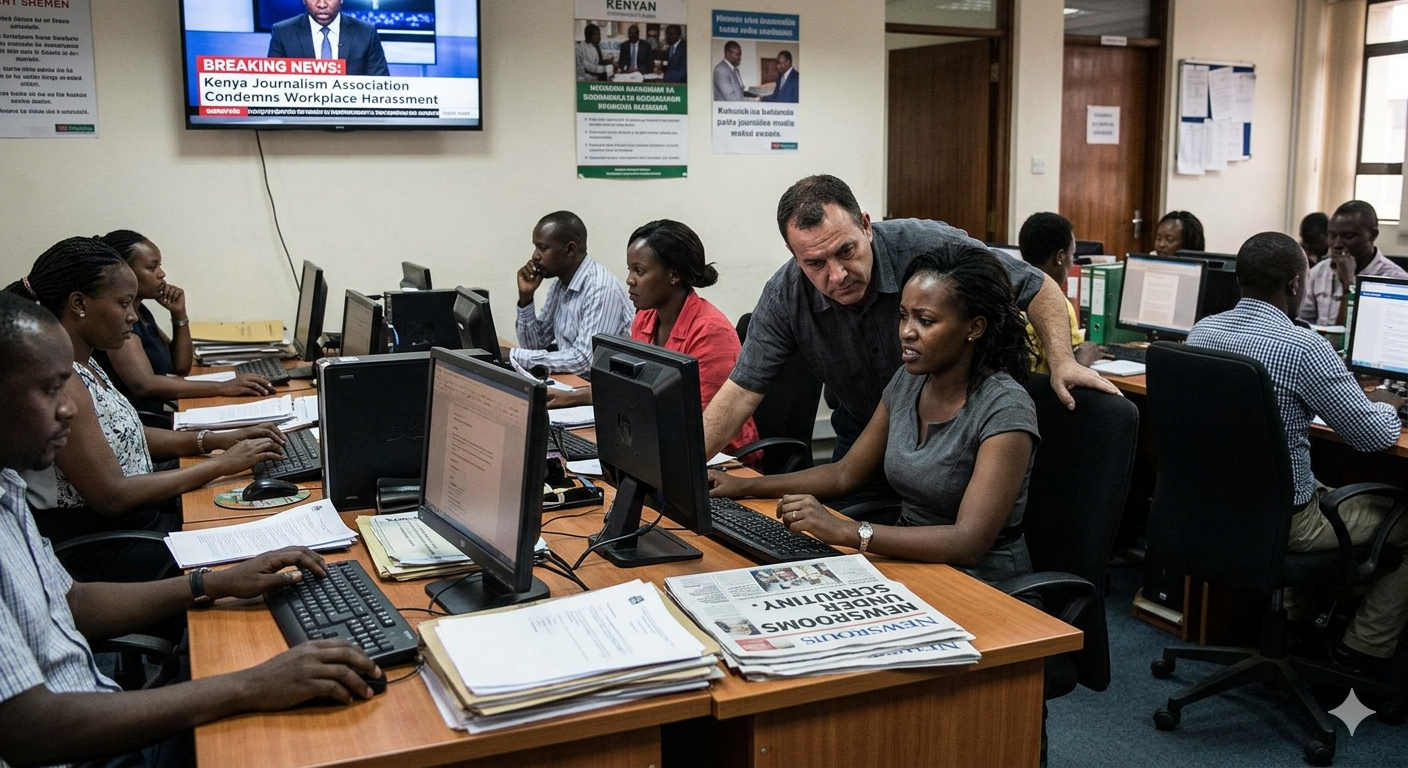
The study found that for all types of incidents except online attacks, women experienced sexual harassment at roughly double the rate of men. Online harassment affected men and women similarly. Globally, women were 2.4 times more likely than men to experience verbal sexual harassment and 1.8 times more likely to experience online sexual harassment.
Physical harassment and rape remain consistent threats. A quarter of all respondents reported physical harassment, with 5% of women and 4% of men identifying as rape survivors.
Despite the prevalence, 69% of those who experienced harassment across all genders did not report it, continuing a longstanding pattern of underreporting found in earlier studies. Where incidents were reported, organisations took action in only 65% of cases, most often through limited or informal measures.
Fear of retaliation, lack of trusted reporting mechanisms, and low confidence in organisational response were cited as key reasons harassment goes unreported. Researchers said this reflects structural barriers and a lack of accountability in media workplaces. Lower response and reporting rates among men also suggest harassment is still widely perceived as primarily a women’s issue, despite its broader impact on newsroom culture and journalistic integrity.
‘Normalised as flirting’
The study defines sexual harassment as “unwanted and offensive behaviour of a sexual nature that violates a person’s dignity and makes them feel degraded, humiliated, intimidated or threatened”. The prevalence for a given country or region is calculated as the mean average of respondents who reported ever experiencing verbal harassment, online harassment, physical harassment, and/or rape while at work.
Qualitative responses highlighted how harassment is often minimised. A male multimedia editing manager aged 35–44 said: “(Sexual harassment) happens in subtle ways, so much so that it is normalised as flirting.” A female radio intern aged 18–24 remarked: “(Sexual harassment) should be taken with a lot of seriousness, but the people responsible to make that happen are the perpetrators.”
A Kenyan male radio journalist aged 35–44 added that creating awareness is key because “many people who go through this are stigmatised.”
Impact on journalism
Dr Lindsey Blumell of City St George’s, University of London, said the research shows harassment has a deeply negative impact on victims and on newsroom atmosphere.
“No matter the type of harassment, experiencing it decreases job satisfaction, increases risk of leaving the industry, and causes many other negative mental and even physical consequences to victims/survivors,” she explained.
Dr Blumell also noted that underreporting reflects a lack of trust in reporting systems and signals an overall acceptance of violence in newsrooms.
Valeria Perasso, Media Development Advisor at BBC Media Action, said addressing sexual harassment is not only about individual protection but also about newsroom governance and journalistic integrity.
“Unsafe and unequal workplace cultures create structural barriers that limit who can participate, lead, and shape editorial decisions, and ultimately, journalism suffers,” she noted. “We hope this report will help inform organisational action and leadership practices in individual newsrooms and across the media sector, as well as policy and advocacy, contributing to safer, more inclusive, and equitable media institutions.”
Susan Makore, Managing Director of WAN-IFRA Women in News, said that when the majority of cases continue to go unreported, it signals “a deeper failure of workplace culture, trust, and accountability.”
Multi-Response
The findings come against a backdrop of several initiatives in Kenya. Kenya’s legal framework on workplace sexual harassment is governed by Section 6 of the Employment Act (2007), which requires employers with 20 or more employees to adopt and implement sexual harassment policies and procedures, including internal reporting and disciplinary mechanisms. Implementation challenges have been noted in practice, highlighting the need for effective enforcement and organisational compliance.
In August 2025, Aga Khan University’s Graduate School of Media and Communications published a policy brief highlighting that sexual harassment is rife in Kenyan, Tanzanian, and Ugandan newsrooms. The university has trained more than 400 journalists across the three countries to help tackle the issue. The Association of Media Women in Kenya (AMWIK) was also mandated by the Kenya Media Sector Working Group to lead awareness and response actions. In 2025, WAN-IFRA WIN and the Kenya Union of Journalists (KUJ) conducted training on sexual harassment awareness for junior journalists and managers.
Methodology and scope
The 2025 study builds on earlier research conducted in 2018 and 2020, expanding coverage to Ukraine, Sierra Leone, Bangladesh, Ethiopia, Somalia, and South Sudan. Respondents spanned journalism, administration, HR, production, marketing, and management, offering a comprehensive picture of how harassment is experienced across media organisations.
The survey instrument comprised 33 closed questions and one open-ended question. Each network aimed for a balance of respondents by gender, role, and media organisation type. Response rates and sample sizes varied by country. Given the sensitivity of the subject, respondents were given access to relevant support resources. Data was handled in accordance with City St George’s, University of London’s privacy policy and international data protection standards.
Totals include gender non-conforming individuals and those who prefer to self-describe, though data is not disaggregated for these groups at country level. While the total Kenyan sample was 157, some respondents did not complete the survey in full, so certain demographic responses are based on a smaller number of participants.
Call for action
The study concludes that sexual harassment in media is not an isolated workplace issue but a structural barrier that shapes who feels safe to participate, stay, and lead within journalism. Addressing it, researchers say, requires more than policies alone.
Media organisations must invest in sustained awareness raising, training, and sensitisation at all levels of the newsroom to help shift workplace cultures, strengthen reporting mechanisms, and ensure harassment is recognised, addressed, and not normalised.
“Safer and more equitable media workplaces are essential to building stronger, more inclusive, and resilient journalism,” the report states.