

The future of journalism in Kenya may belong to the media organisations that adapt fastest to digital behaviour, audience psychology, AI discovery, and the changing economics of attention.
NAIROBI, May 2026 -A new report by the Media Council of Kenya (MCK) paints a worrying picture for the future of newspapers in Kenya, as readership continues to collapse while audiences rapidly migrate to social media and mobile platforms.
Weekly newspaper readership has fallen from 29% in 2022 to just 13% in 2025, while social media has now overtaken television as Kenya’s leading source of news at 39%.
These figures reveal shifting audience habits and expose a deeper economic and structural crisis that threatens the future of newspaper journalism in Kenya.
How Newspapers Once Controlled Public Attention in Kenya
For many years, newspapers shaped public conversations across Kenya. Morning routines often began with newspapers in homes, offices, restaurants, and public transport. Newspapers influenced politics, business, education, and national debate.
That environment has changed rapidly.
Today, many people receive news through their phones long before they encounter a newspaper stand. News now spreads through social feeds, messaging apps, online videos, trending conversations, and AI-generated summaries. The modern audience no longer waits for tomorrow’s newspaper to know what is happening.
This shift is changing the economics of journalism.
A newspaper depends heavily on large readership numbers to sustain advertising, printing, staffing, and distribution. Once readership falls sharply, the entire business structure begins to weaken.
Fewer readers reduce circulation, and declining circulation weakens advertising value. Declining revenue, in turn, creates pressure on payroll, printing costs, regional offices, and newsroom operations.
That explains why the drop from 29% to 13% matters so much. The numbers point to a shrinking print audience that is becoming harder and more expensive to serve.
Why Newspapers in Kenya Are Losing Revenue
Producing newspapers has always required major operational investment. Media houses must pay for printing plants, transport, newsprint, editors, photographers, correspondents, and distribution networks across the country. These costs become difficult to sustain when circulation and advertising revenue continue falling.
This elucidates why newsroom restructuring has already become common in Kenya’s mainstream media industry.
Nation Media Group has in recent years faced growing financial pressure linked to declining advertising revenue and audience migration toward digital platforms. Reports indicate the company started shutting down some regional operations, including the Mombasa bureau, as part of wider cost-cutting measures.
The Standard Group has also struggled financially. In 2024, the company announced plans to lay off hundreds of employees amid shrinking revenues, salary delays, and restructuring efforts to reduce operational costs.
These developments show that the crisis has moved beyond theory and is already affecting journalists, editors, photographers, regional correspondents, and support staff across the country.
The deeper challenge lies in the collapse of the traditional newspaper revenue model.
For decades, newspapers relied heavily on advertising from corporations, government institutions, universities, banks, and retailers. Print advertising once offered predictable audience reach and national influence.
That model is weakening quickly.
Advertisers now have cheaper and more targeted digital alternatives. Brands can reach audiences directly through online campaigns, influencers, search engines, and social platforms while accessing detailed analytics and real-time performance tracking.
Advertising money has followed audience attention.
As audiences spend more time online, advertisers are increasingly directing their budgets toward digital platforms. Newspapers are therefore competing for shrinking advertising revenue while still carrying high operational costs associated with print production.
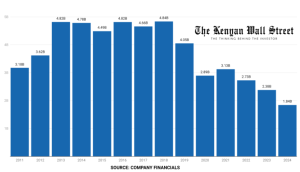
The Standard Group’s 2024 annual report showed that revenues fell sharply due to reduced advertising spending and lower audience engagement.
The Attention Migration Framework
The newspaper crisis in Kenya can be understood through what may be called the Attention Migration Framework.
The collapse began with a shift in audience attention long before it reached the printing press. The process followed a clear pattern:
- Newspaper revenues weakened
- Newsrooms downsized operations.
- Audiences shifted to mobile phones.
- Advertisers followed audience attention.
- News consumption moved to digital platforms.
- Platforms gained stronger control over news distribution.
The newspaper crisis extends beyond journalism and reflects the changing economics of audience attention in the digital age. The publisher still produces much of the journalism. The platform increasingly captures the audience’s attention.
Why Subscription Journalism Is Struggling in Kenya
The crisis is also affecting digital subscription strategies. As print revenues declined, many newspaper publishers introduced subscription-based models hoping to build a more stable digital revenue stream through paid content, premium reporting, and loyal online audiences.
The MCK report indicates that 55% of Kenyans do not regularly visit news websites directly. Many people now encounter news through reposted links, screenshots, forwarded messages, short clips, and online commentary instead of visiting publishers’ websites. This weakens the direct relationship between publishers and readers.
Subscription journalism depends heavily on routine and loyalty. Readers must consistently visit a platform, trust its reporting, and feel enough value to pay for access.
Audience attention is increasingly happening away from publisher websites, making it harder for media houses to build stable subscription revenue.
The publisher produces the journalism and the platform captures the attention. This shift is also weakening homepage loyalty.
Many readers now consume headlines without developing long-term attachment to specific news brands. That creates serious challenges for subscription-based journalism models that depend on repeat engagement.

How Artificial Intelligence Could Deepen the Newspaper Crisis
Artificial intelligence may deepen the pressure even further. AI-powered search tools are increasingly summarising information directly for users. Many people now consume information through AI-generated overviews without clicking the original source. This may reduce website traffic, advertising impressions, and subscription opportunities for publishers that depend heavily on search visibility.
The challenge for newspapers is no longer only about publishing stories. It is increasingly about discoverability.
Media houses that fail to optimise their journalism for search visibility, AI extractability, and digital discoverability risk becoming less visible even when producing quality journalism.
This is where the future of journalism intersects with Search Engine Optimization (SEO), G (GEO), digital PR, and platform visibility.
What the Future of Newspapers in Kenya May Look Like
The future of newspapers in Kenya will depend heavily on reinvention.
The newspaper that survives will no longer operate only as a printed product. It will function as a digital knowledge brand built around trust, authority, analysis, and multi-platform visibility.
That future may include:
- Data journalism,
- Premium investigations,
- AI optimised publishing,
- Smaller print circulation,Newsletters and podcasts.
- Live events and conferences,
- Leaner newsroom operations,
- Stronger digital video production,
- Stronger journalist personal brands.
Print newspapers may continue surviving as premium products focused on investigations, analysis, opinion pieces, archives, and specialised reporting. The era of newspapers as the dominant daily source of mass information is steadily fading.
The State of the Media 2025 Report reveals changing audience habits and the slow collapse of the traditional newspaper business model in Kenya.
Kenyans still consume news every day. The difference is that they now discover, consume, and interact with it differently, through platforms that traditional newspapers no longer fully control.
The future of journalism in Kenya may not belong to the biggest printing press.
It may belong to the media organisations that adapt fastest to digital behaviour, audience psychology, AI discovery, and the changing economics of attention.
Hezron Ochiel is a Strategic Communications Expert at Kenya Medical Training College (KMTC), a PRSK Moran Award 2025 winner, and the founder of Hezron Insights.


The Idear makes the reality with the facts to all Media house that there’s a big change through social media and Digital platforms
All will be well because world do a lot of changes for the coming generation