
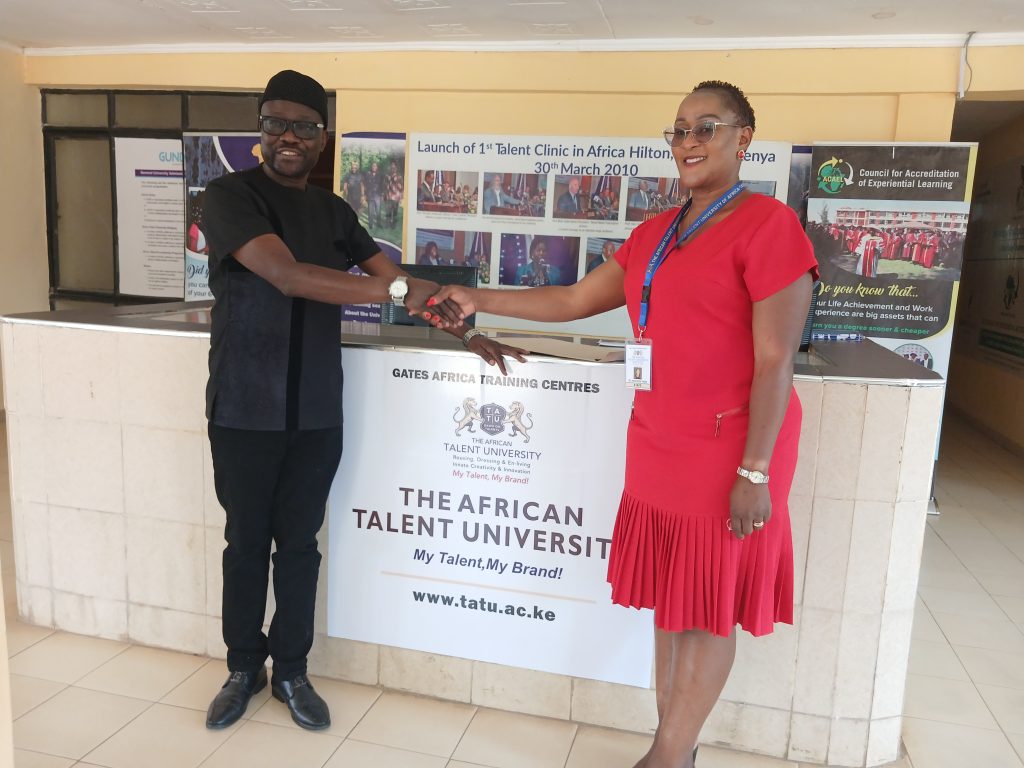
KISUMU,30th July 2026–The African Talent University (TATU) has unveiled Dr Redemptah Yeda as its new Acting Vice-Chancellor.
Dr Yeda brings a wealth of experience to the institution, holding a Master’s degree in Epidemiology and Biostatistics and a Bachelor of Science in Public Health, both from Jaramogi Oginga Odinga University of Science and Technology (JOOUST).
She boasts 16 years of professional experience as a Senior Laboratory Technologist and Assistant Research Officer at the Walter Reed Project and the Walter Reed Army Institute of Research, spanning from March 2010 to 2026.
”I am here to see this university scale to higher levels, ensuring that our talent base, experiential learning, and academic programs are fully realized,” Dr Yeda stated during a media briefing at the main campus in Buoye, Kisumu East Sub-County.
“My main goal is to ensure that the surrounding community benefits directly from the unique learning models offered here.”
Addressing the upcoming academic calendar, Dr Yeda called upon the local community and the wider region to embrace the university and enroll for the September intake, emphasizing that the institution offers crucial financial relief and accessible pathways to higher education.
Welcoming her to the post, TATU founder and sponsor Prof Humphrey Oborah highlighted the university’s commitment to gender equity and regional diversity in leadership. Noting that women are equally capable of holding executive university roles, he emphasized that Dr Yeda, who hails from Kapenguria, reflects the diverse face of Kenya.
Prof Oborah added that the university will soon announce a new Chancellor, a former Prime Minister from West Africa, to succeed the late Raila Odinga, who remains registered as the founding Chancellor. This step aligns with TATU’s mission to operate as a continent-wide institution addressing uniquely African challenges.
The appointment comes on the heels of TATU’s official government accreditation in April 2026.
However, Prof Oborah expressed concern over the demographics of the initial May intake, revealing that over 90% of the students came from outside Kisumu County, primarily from Central Kenya, the Rift Valley, and Western Kenya, while local enrollment stood at just 8%.
Following a internal review, the university attributed the low local intake to a lack of awareness rather than a lack of interest.
“Many local residents are simply unaware of TATU’s existence, its government placement status, or its focus on talent and experiential learning.”
Through the Kenya Universities and Colleges Central Placement Service (KUCCPS), TATU has already enrolled over 200 new students, joining a continuing student body of over 350.
“Because the university is officially listed on the KUCCPS portal, eligible students qualify for government funding and loans through the Higher Education Loans Board (HELB).”
To bridge the awareness gap, TATU plans to host a major promotional launch on August 14th in partnership with the Kisumu County Government, local leaders, and key stakeholders. The initiative aims to guide local applicants through selecting TATU on the KUCCPS portal. Selecting a core program, such as management or psychology, unlocks diverse specialization tracks ranging from business innovation, sports, and green economy to marine sciences, engineering, and medicine.
At Sh47,000 per semester, TATU offers one of the most affordable tuition structures in the region compared to the average Sh70,000 charged by peer institutions. Prof Oborah urged parents not to let qualified students sit idle at home when government funding is available to cover their studies.
TATU sets itself apart through three distinct learning pillars: academic, experiential, and talent-based learning. Using specialized anthropobiometric technology, the university assesses students’ natural physical and cognitive aptitudes such as technical mechanics, spatial reasoning, or sensory skills, to formalize their education. This model allows skilled individuals without formal classroom backgrounds, as well as experienced entrepreneurs, to evaluate their practical track records and earn recognized credentials.
Supported by the African Talent Federation, TATU maintains global contact centers across Kenya, including Nairobi, Nakuru, Mombasa, Eldoret, and Meru, as well as continental hubs in Monrovia, Abidjan, Cape Town, Addis Ababa, Kampala, and Dar es Salaam.
“The institution aims to reshape the higher education outcome: rather than graduating with only academic certificates, TATU students graduate with market-ready prototypes, functional designs, and venture-ready innovations designed to attract direct investment on graduation day,” Prof Oborah assures.