Prof Mutharika will join a list of octogenarian leaders who are still in power
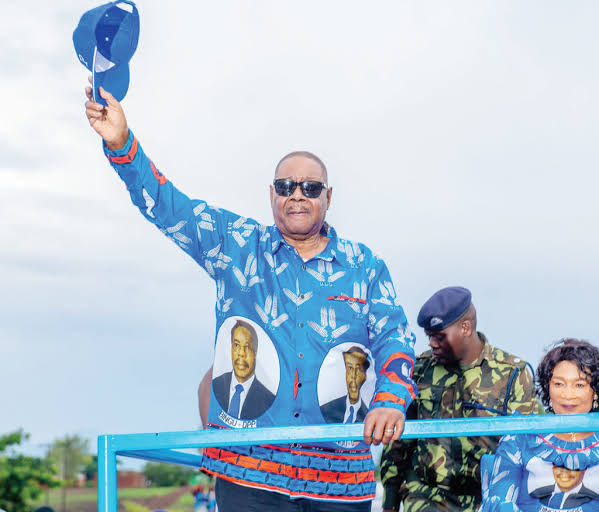
KISUMU, Kenya, September 25th – The election of Prof Arthur Peter Mutharika as the 7th President of Malawi ominously represents a growing list of leaders in Africa who are not yet ready to relinquish power to the younger generation.
Making a grand return to the presidency, 85 Mutharika led the Democratic Progressive Party (DCP) in trouncing the incumbent Dr Lazarus Chakwera’s Malawi Congress Party (MCP) in the historic September 16th presidential polls.
To avoid a possible run-off, he garnered 56.8 percent of votes cast against Chakwera’s 33.2 percent with the latter quickly conceding defeat before Malawi’s Electoral Commission (MEC) made the official announcement.
Neighbouring Zambia, Mozambique and Tanzania, the landlocked Southeastern African countrymen cast a ‘protest vote’ to express their displeasure with 25 percent inflation, kwacha devaluation at 44 percent, and a high poverty index affecting 71 percent of the population.
Prof Mutharika will join a list of octogenarian leaders who are still in power.
His predecessor, Lazarus Chakwera, is aged 70 years. Given the latest events in other African nations, that kind of trend is expected to continue.
In Uganda, the Electoral Commission has cleared long-serving President Yoweri Museveni to seek reelection in elections due to be held early next year,
Museveni has been credited with stabilising Uganda, promoting economic growth, and combating HIV/AIDS. But critics denounce his government’s suppression of political opponents, human rights abuses and corruption scandals.
The president is expected to face off with perennial rival Robert Kyagulani, alias Bobi Wine, while his other challenger, Kizza Besigye, is behind bars over treason charges.
In nearby Rwanda, President Paul Kagame has maintained a stranglehold on the country’s leadership since 1994 after the genocide, which killed hundreds of thousands of people.
The 65-year-old has been the dominant force in Rwanda since his then-rebel group, the Rwanda Patriotic Front (RPF), came to power at the end of the genocide.
But he only became president in 2000 following the resignation of Pasteur Bizimungu.
In 2003, Rwanda adopted a new constitution giving the president a seven-year tenure renewable once. But, this was amended in a controversial referendum in 2015.
The changes, which were approved with 98 percent of the vote, allowed the president to run for a third seven-year term and then serve two further five-year terms starting in 2024.
Asked about what the West would think about his decision to run again, Mr Kagame told Jeune Afrique that “what these countries think is not our problem.”
Other African leaders who have clung to power for decades include; Equatorial Guinea’s Teodoro Obiang Nguema Mbasogo (43-year rule).
Obiang, who came to power in an August 3, 1979 coup, is Africa’s longest-serving leader, with 43 years at the helm.
“Next month, at the age of 80, he will run for a sixth term lasting seven years.”
Cameroon has lived through 40 years of largely unchallenged and hardline rule under Paul Biya. The 89-year-old runs the country through a very small circle of aides, whom he appoints and banishes as he sees fit.
It’s a taboo to openly talk about succession even for his closest supporters, and Biya has overseen a ruthless crackdown on dissent since his highly contested re-election in 2018.
At 78 years old, Denis Sassou Nguesso of the Republic of the Congo has been in power for 38 years, albeit not uninterruptedly. He was president from 1979 to 1992, then returned to office in 1997 after a civil war.
Nguesso was re-elected in 2016 after the passing of a new constitution, then won a fourth mandate on March 21 this year.
Africa’s last remaining absolute monarchy, Eswatini located in the south, has been ruled by King Mswati III for 36 years. He ascended to the throne in April 1986 aged just 18.
His Eritrean counterpart, Isaias Afwerki, 76, has ruled the Horn of Africa nation with an iron fist since independence in May 1993. (Photo Courtesy)
Fredrick Odiero is an experienced journalist who has written extensively about governance and democracy in Africa for various media platforms.