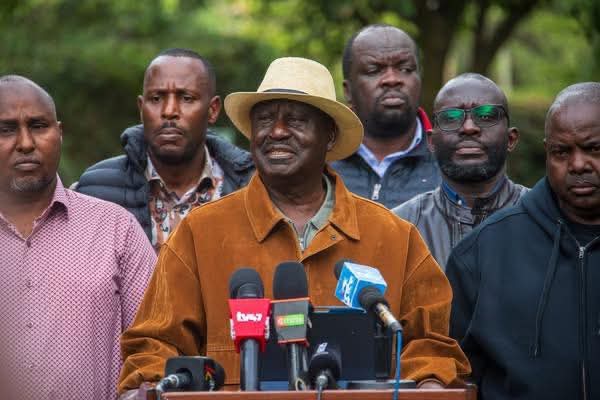
NAIROBI, Kenya, July 9 – Kenya’s former Premier Raila Odinga has issued an appeal for national dialogue, aimed at addressing growing political and economic issues bedevilling the country.
Speaking on the 35th anniversary of Saba Saba – a significant moment in Kenya’s democratic history, Mr Odinga highlighted the need for a united, intergenerational conversation to help direct the country towards reform and stability.
Saba Saba, which is a Swahili word for ‘Seven Seven,’ refers to July 7 1990- the day Kenyans took to the streets demanding political freedom and multiparty democracy.
The protest was, however, violently subdued, but it led to the revocation of section 2A of the constitution and the return of multiparty democracy in 1991.
In his statement, Odinga lamented that the importance of saba saba has not been consistently honoured over the past thirty-five years.
“One moment it holds great importance, the next it seems insignificant. We have chosen to remember and clarify its significance, to reflect on what it was, how it affected us, and to consider what we should do with the foundation it laid for the country,” he added.
Odinga recalled how renowned figures such as Charles Rubia, Kenneth Matiba, Gitobu Imanyara and himself were arrested in the original Saba Saba protests.
The movement succeeded in bringing people together – young and old, professionals and activists, to demand change, despite the suppression.
“Saba Saba was inclusive, democratic and intergenerational,” he stated while adding that; “It was not one group against another. The movement stood for a peaceful and constitutional change of guard.”
Odinga attributed the Saba Saba movement for paving the way for the constitutional changes that came in 2010, giving Kenyans greater freedom and rights.
Raila, however, warns that the country now faces a new wave of unrest and political discontent, especially among the youth.
“Thirty-five years later, the country is grappling with a new wave of unrest and political activism. The biggest challenge facing Kenya today and into the foreseeable future is how to expand economic opportunity and life, particularly for young Kenyans, out of poverty, exclusion and unemployment,” he noted.
To address these anomalies, the ODM Party leader suggested the formation of a national intergenerational conclave.
“This platform serves as a dialogue space, bringing citizens together from various age groups, regions, and backgrounds to discuss and reach consensus on important reforms, emphasised Odinga.
He suggested that the reform should focus on; comprehensive police reforms to enhance transparency and improve relations with the public.
Stronger accountability mechanisms to combat corruption and impunity among leaders, and lastly, sustainable strategies to tackle youth unemployment and create jobs in both formal and informal sectors, are some of the key reforms outlined by Mr Odinga.
“The country is yearning for programs and leaders that prioritise inclusivity, social justice and political freedom. Our leaders must become modest, ethical, humble and accountable,” he emphasised.
He further proposed that the result of the national dialogue should be subjected to a referendum, allowing Kenyan citizens to decide on the way forward.
As one of the original founders of the Saba Saba movement, Odinga’s statement serves both as a call to action in the face of current challenges and a reminder of Kenya’s democratic journey.
He urged Kenyans to come together to chart a better path for the future, grounded in justice, transparency and opportunity for all.