MOMBASA, 31st December –In Kenya, a national ID card or a birth certificate is more than just plastic and paper; it is a “digital soul.” Without it, you cannot legally work, bank, vote, or even prove who your parents are.
However, for millions of Kenyans, particularly in the Coast region, acquiring these documents has become an expensive, exhausting, and often impossible hurdle.
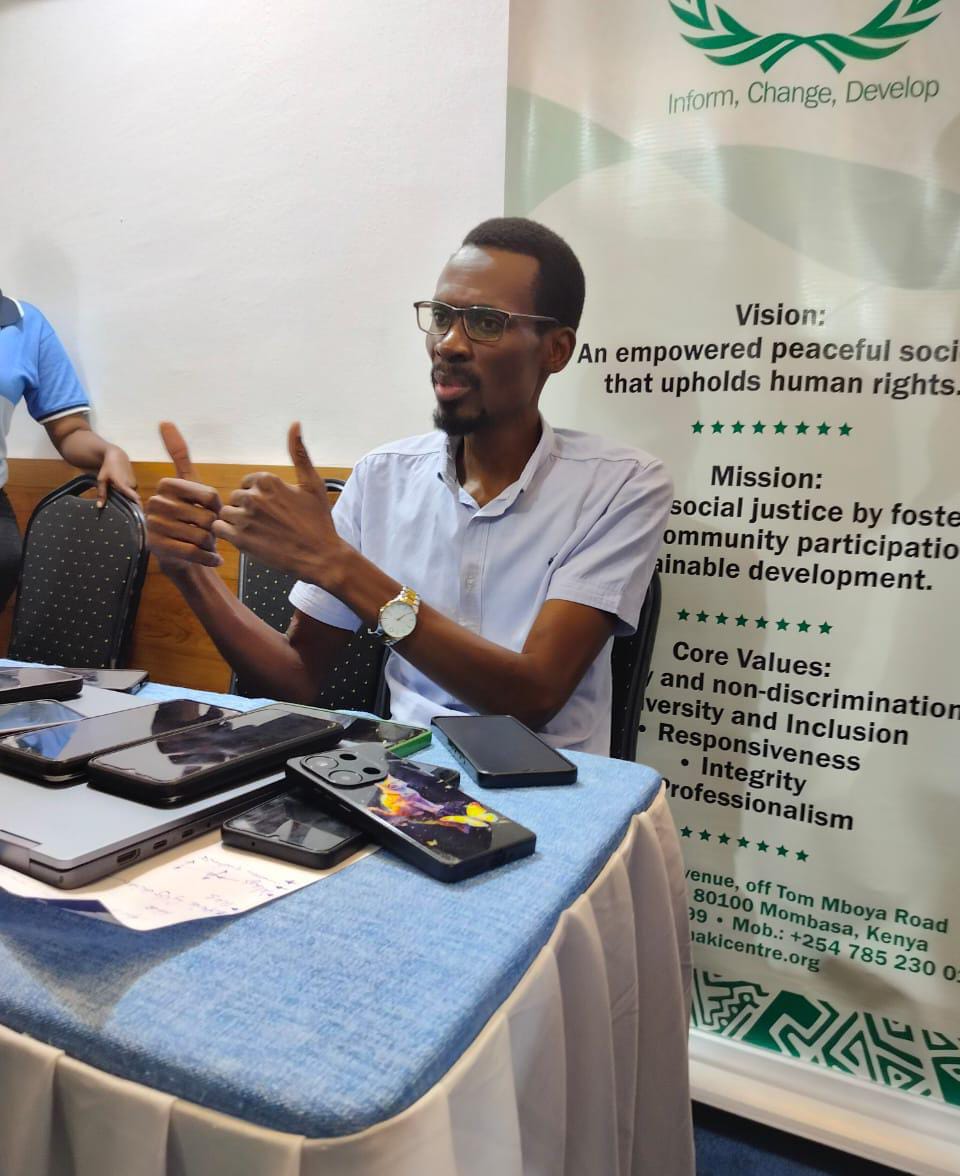
At a recent media forum in Mombasa, held by the Haki Centre, a sharp alarm sounded on two crises: a system that excludes entire communities and a bureaucracy that punishes citizens for clerical errors.
Speaking during the Haki Centre training with media personnel and CSOs, Program Officer Andrew Ochola highlighted their organisation’s data, which shows that one in every ten Kenyans currently faces significant difficulties in civil registration.
For communities like the Pemba and Makonde, the struggle is rooted in “vetting” a discriminatory practice that treats certain citizens as guilty until proven Kenyan. ”The process disadvantages the less privileged, we recommend the complete removal of vetting. It creates a gap where those who were under 18 during previous mass registrations are now stranded without documents,” stated Ochola.
When Errors Become Life Sentences
The crisis isn’t just about who has an ID; it’s about what is written on them. A single misspelt name on a birth certificate can derail a life for decades.
The School Certificate Deadlock, thousands of students face a nightmare when their birth certificate spelling doesn’t perfectly match their Kenya Certificate of Primary Education (KCPE) or Kenya Certificate of Secondary Education (KCSE) exam records.
State agencies like Kenya National Examination Council (KNEC) and the Department of Immigration often refuse to recognise “sworn affidavits,” demanding instead a formal amendment of the original birth record, a notoriously difficult process.
“The Haki Centre is demanding an immediate overhaul of the ‘pay-to-be-Kenyan’ model, arguing that current fees for birth certificates and IDs are a financial wall for the poor. By pricing out the most vulnerable, the state effectively makes citizenship a luxury,” said the program officer.
To fix this, Ochola is urging the government to move services from city offices to village squares, scrap unfair legacy policies, and staff these outposts sufficiently to clear the backlog of the forgotten.
The Man Who Took 15 Years to “Exist”
Among those who have felt the crushing weight of this system is Juma Peter, a 42-year-old former addict whose life was nearly erased by paperwork.
Having grown up on the streets without parents, Juma lacked the very first thing the government asks for: his parents’ ID photocopies.
“How can I produce documents for people I never knew?” Juma posed.
“I’m a father now after reforming from rehabilitation centre l wanted a family and the sad part is that even my child can’t get birth certificate because the mother and l can’t produce my Identification card to secure her birth, l can say that after fifteen years of struggle l’m now relieved I have a waiting card hoping to participate in the forthcoming elections for the first time in my life,” Juma narrates
For over a decade, his life was a revolving door of poverty and prison vulnerabilities he attributes to his lack of legal identity. Without an ID, he couldn’t secure formal work or stable housing, often ending up on the wrong side of the law.
After fifteen years of being referred between offices and eventually giving up in despair, a breakthrough finally came through the Commissioner’s office.
Today, he finally holds a “waiting certificate”—the first proof in four decades that he is a Kenyan citizen. His story is a stark reminder that for the homeless and orphaned, the current system doesn’t just “vet” them, it abandons them.
A Typo that Stole Mwadime’s Future
The systemic failures of the registration process are perhaps most visible in the life of Brenden Mwadime, a 21-year-old from Taita Taveta. Raised by his grandmother following his mother’s death, Brenden’s struggle began with a single clerical error on his KCPE result slip.
In a bizarre administrative oversight, he was mistakenly identified as a girl, with his name recorded as “Brenda” instead of Brenden. This minor typo has had catastrophic consequences: for years, he has been unable to secure a job, open a bank account, or apply for a National ID because his school records do not match his identity.

”I have sought help everywhere from the Chief’s office to the Ministry of Education, but I am a jobless youth living hand-to-mouth. These offices require me to travel back and forth, and I simply cannot afford the transport anymore just to estimate the amount I have used on this is between Sh 7,000 and Sh 10,000,” Mwadime shared.
After months of being bounced between authorities, Brenden nearly lost hope and abandoned the vetting process entirely.
Today, he relies on the Haki Centre, which is currently working to navigate the expensive and bureaucratic maze of correcting his primary school records. His case highlights a cruel reality: in Kenya’s current system, a simple spelling mistake can effectively delete a young man’s future.
Once a child passes age two, fixing a name error often requires a Deed Poll and a paid notice in the Kenya Gazette. For a family living in poverty, these legal fees and travel costs to distant Huduma Centres are an insurmountable wall.
A Call for Radical Reform
The Haki Centre is calling for more than just “efficiency; they are demanding a total overhaul of the civil registration philosophy. Their key recommendations include; Issue Haki Centre Recommendation, Immediate abolition of vetting for all eligible Kenyans, and waive fees for errors caused by government clerks.
Other suggestions include decentralising services to the grassroots to save citizens’ travel costs, and reviewing the prohibitive costs of IDs and birth certificates for the poor.
The Human Stakes
As Kenya approaches the next election cycle, the lack of documentation is a growing democratic crisis. Without an ID, a citizen’s voice is silenced. Without a birth certificate, a child’s future is stopped at the school gates.
The Haki Centre is currently working to help Brenden “correct” his records, but they shouldn’t have to. The forum concluded with a clear message: A typo should not be a life sentence. The government must stop treating documentation as a privilege and start treating it as the fundamental right the Constitution promises.