KISUMU, Kenya- In light of the unfolding events following Raila’s death, I have argued that we have now entered a true post-Odinga era, an era in which the very machinery that sustained Odingaism has also succumbed to its own tragic inevitability.
On October 31st, I introduced this claim; on November 4th, I laid out the theoretical framework that anchors it. My initial plan was to release the full argument in four separate instalments, each building slowly toward the next. But I have decided to present everything, the balance, the actual reasoning, at once, in this single post.
Two reasons explain this change of mind. First, I have received numerous messages from readers who have grown understandably impatient and eager to follow the argument to its logical conclusion.
Secondly, and perhaps more importantly, the political landscape is shifting with remarkable speed as the nation hurtles toward the 2027 elections. In moments like these, timing should be both strategic and historical. I feel compelled to put my full argument on record now, while the tremors are still vibrating through the political ground on which ODM once stood.
I present three core arguments as to why ODM must die, before I conclude, comparing ODM and others, ANC, CCM, even as I revisit the idea of “fate”.
Argument 1: The Unfillable Leadership Vacuum
With Raila’s death, ODM as a party is unlikely to survive because the leadership vacuum he leaves behind is, quite frankly, unfillable, both within ODM and outside it. Three points suffice for this claim.
First, watching the speeches by the political sycophants, some of whom even christened themselves “orphans” during the burial rituals at Kang’o ka-Jaramogi, we are reminded of a long-held truth: ODM’s leadership was never elected by anyone.
They were picked, hand-selected, one by one, by the late Raila Amolo Odinga. A leadership chosen not through democratic processes but through personal loyalty and historical proximity to the party leader naturally became detached from the spirit and original vision of the party. And because it was built around a patron, it can only, and very quickly, shift allegiance to the next patron.
Indeed, Mbadi and others who spoke hinted, directly or indirectly, that their loyalty had already drifted toward President William Ruto. And here lies the naked reality: ODM politicians neither know how to elect leaders nor have they ever cultivated that tradition.
They cannot learn it overnight. Any attempt at internal democracy now, ironically, the only thing that could save the party—will divide it into fragments and possibly shatter it altogether.
Secondly, the absence of a culture of elective leadership within ODM is laid bare in the decision to install the octogenarian Senator Dr Oburu Odinga as acting party leader. Why not Simba Arati? Why not the eminently qualified Prof. Nyong’o? Why not the fiery and popular Gladys Wanga? Because these presumed “next-in-line” figures were never groomed through a structured, capacity-based succession plan.
They simply benefitted from Raila’s presence and were therefore never assessed for their ability to carry the ODM mantle into a post-Raila era. They are consequently—by ODM’s own logic—automatically unqualified in this new reality. Even more ironic is that Oburu himself has repeatedly said the party has no shortage of leadership talent, especially among young, capable leaders who can serve both ODM and the Luo nation.
Yet he is the one thrust forward as the temporary holder of Raila’s immense political shadow. Why? Although others may have been next in line, none of them were truly chosen by Raila, and the party barons do not trust any one of them to lead. It will take time before such a consensus forms, and by the time it does, Odingaism will already have drifted into the museum of Kenya’s micro-ideologies.
Thirdly, ODM is on the verge of a mass exodus. As I have argued before, the party was Raila and Raila was the party. Voters did not cast their ballots because they were mesmerised by some well-thought-out manifesto; they did so because candidates came to them and pleaded for votes on the strength of standing with Raila and with ODM.
That spell has now been broken. Electorates will begin searching for leadership talent both inside and outside ODM, and the misleaders who form the bulk of its visible ranks will likely rebrand themselves—many through new party tickets. When that happens, ODM’s bargaining power, which for nearly two decades made it the most sought-after party for post-election coalitions and expanded governments, will collapse.
A party without mass following becomes a party without threat, and therefore irrelevant to incumbents who bargain only with those who can deliver. Without Raila, ODM is quickly sliding toward the league of DAP, DP, and other politically inviable shells.
And complicating this already delicate equation is yet another factor; the open contest now emerging between ODM opportunists, those feeding from or angling toward the current government, and the technocrats and strategists who are thinking beyond 2027. That internal tension is about to make the vacuum even deeper, and the fragmentation even faster.
Argument 2: Opportunists Versus the Experts
ODM’s fate is tragic because it is now split between opportunists and futurists, between those scrambling to survive politically in the post-Raila moment and those who still believe a future is possible only if ODM remains a strong negotiating machine.
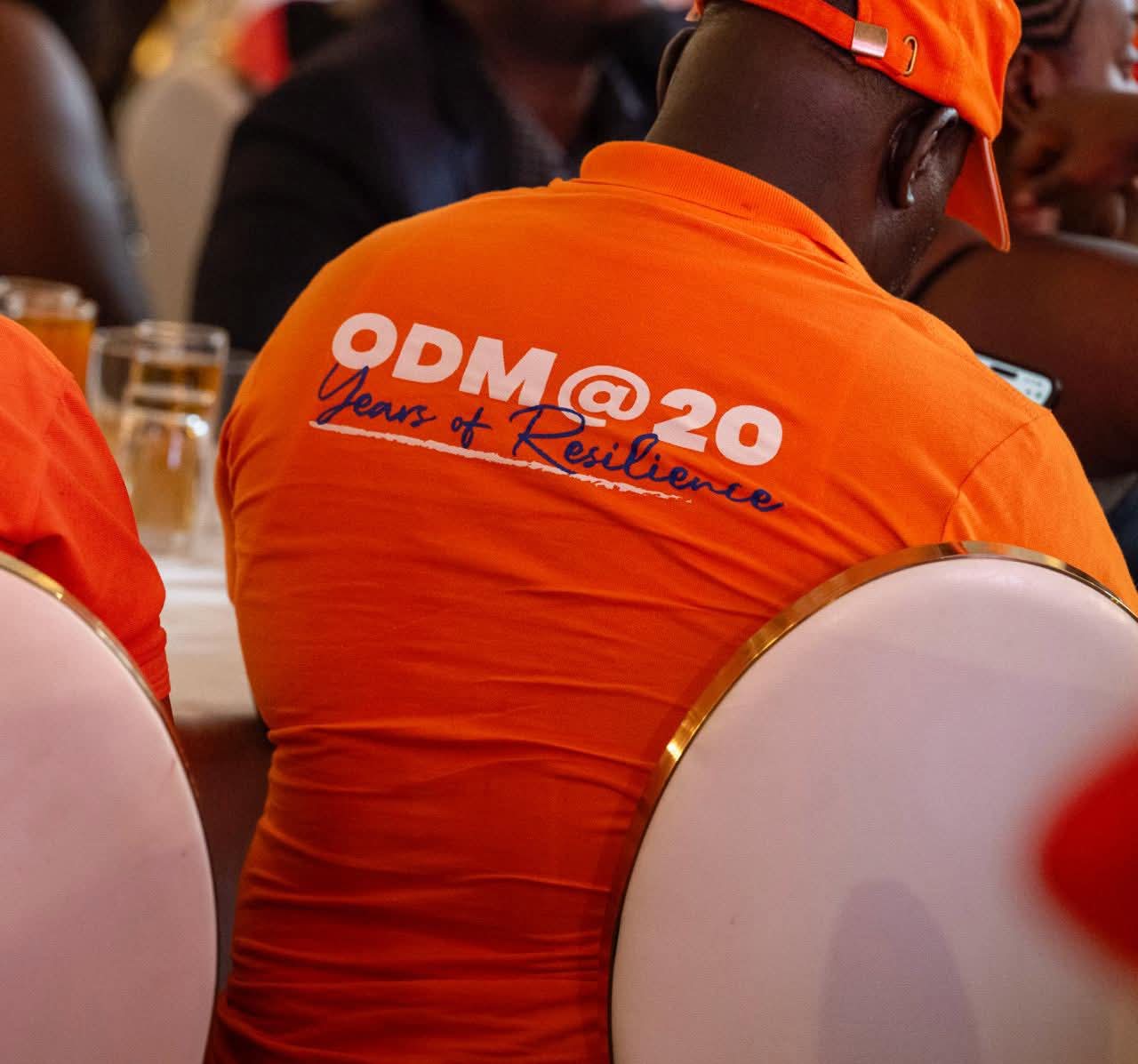
In this post-Odingaism terrain, the first faction is driven purely by survival, even if that survival demands “selling the party during pillow talks,” as Winnie sharply quipped during the ODM@20 gathering. Their logic is simple, even if embarrassingly short-sighted: with Raila no longer here to secure their re-elections, their access to resources, and their presence in those high-level corridors where consequential national decisions are made, what else can they do but seek refuge under President Ruto’s goodwill, goodwill which, at least for now, appears dependable?
This is the faction that has spoken the loudest since Raila’s passing. Their hunger for relevance is palpable. They are not interested in the party’s soul or its future. They refuse to acknowledge that their past victories, their insulation from political storms, and even their survival despite rampant incompetence were all guaranteed because ODM was too strong to be ignored, untouchable, even by sitting governments.
One need not dig deep to see this. Just look at the embarrassing circus put up by Homa Bay County’s top leadership during the Public Accounts Committee grilling. A whole professor acting as county secretary, a governor, and an entourage of supposedly “learned” officials could not answer a single basic accountability question. Not one. My county, bewitched. Yet this was possible because they were ODM, after all. The party’s name, rather than their competence, had been their shield.
Paradoxically, this survivalist faction includes fairly young and ambitious figures who, by instinct, should be thinking about rebuilding ODM in the post-Raila era. But instead, they justify their opportunism as “strategic,” too blind to realise that their brand of strategy is actually the party’s death sentence.
Some of the leading extremists of this faction, Hon. Samuel Atandi and a key party administrator, Mr Dennis Onyango, have already declared that ODM is too weak to field a presidential candidate and therefore has no option but to support President Ruto in 2027. According to their reading, no one within ODM can face Ruto. So ODM must simply surrender.
Did ODM become weak overnight? Yes. As I wrote on 16 October 2025, Odingaism was powerful but fatally fluid, too dependent on one man, Raila Odinga. Its collapse was predictable the moment centre gave way. The fault lines emerging now, especially between survivalists and long-term strategists, will only accelerate the party’s demise.
While the survivalists are obsessed with the present, determined to remain within Ruto’s orbit until at least 2032, the long-term thinkers understand that ODM’s future can only be secured through strength, autonomy, and negotiation power.
These are the sober minds, the ones who actually think in decades, not months. Raila relied heavily on them. They include Dr. Oduor Ong’wen, Prof. Anyang’ Nyong’o, Dr. Otiende Amollo, and two Odinga’s—Ruth Odinga, who seems to be listening closely to Prof. Nyong’o and Orengo, and Winnie Odinga, who has shown a growing instinct for political incorrectness.
If one wants to understand the intellectual backbone of this faction, watch the interview between Dr Otiende Amollo and the Spice FM journalists. The picture he paints is clear: there is absolutely nothing left for ODM members if the Ruto administration succeeds in swallowing the party.
Ruto, according to Daktari, should not come anywhere near ODM’s internal management. If he does and succeeds, the survivalists may smile today, but they will vanish tomorrow. Junet Mohamed captured this perfectly during the ODM@20 meeting on 16 November when he warned that if caution is not exercised, “everyone will have their share of ODM.” That warning was not poetic. It was prophetic.
And since the interests of opportunists and experts are fundamentally irreconcilable, the trajectory is obvious. Factions will form, two or more. ODM A and ODM B. And the moment that happens, ODM, as we have known it for two decades, will be dead on arrival. Because right now, the conditions for division are ripe, and the centrifugal forces are already pulling apart the last threads holding the party together.
From where I sit, ODM is headed for fragmentation, inevitable, unavoidable. Its fate as a strong, cohesive, vibrant political outfit is slipping rapidly into the past.
Argument 3: The Kingpin-ship Versus Party Consolidation Wrangles
While ODM has an immediate crisis to confront in the aftermath of Raila Odinga’s passing, namely, the task of filling an immense leadership void, the party’s demise is being hastened by a deeper internal contradiction.
The simultaneous pursuit of Luo kingpinship and party consolidation among ODMists who self-identify as candidates for the same. These two ambitions are fundamentally incompatible. The opportunist faction appears unable to choose between capturing ODM’s institutional machinery and positioning itself as the cultural and political heir of the Luo nation.
Yet history shows that no leader can successfully graft themselves into Raila’s mythical stature while also attempting to build, democratise, and stabilise the party he left behind. One cannot simultaneously resurrect a party and crown oneself a king.
If ODM fails to organically converge around a singular leader, the Luo community may wait half a century before a new political patriarch emerges. Leadership myth-making takes decades; it is not manufactured through press conferences, televised tributes, or loud declarations of loyalty. It takes what Luos call juogi (spirits), witchcraft, religion, natural political intelligence, among others, combinations that have only found themselves in the person of Raila.
The scramble we have witnessed since Raila’s death, especially among Governor Gladys Wanga, Opiyo Wandayi, Babu Owino, and John Mbadi, reveals raw ambition rather than a structured ideological succession. Each of these figures is manoeuvring, subtly and aggressively, to occupy symbolic space once held by Raila.
Yet none possesses the liberation history, national political capital, or pan-African revolutionary aura that elevated Raila from politician to movement figure. Their authority begins at the county gates and parliamentary corridors; it does not yet resonate at Uhuru Park, at the ballot box in Eldoret, or in the collective imagination of the oppressed.
Governor Gladys Wanga has sought to position herself as the natural steward of Raila’s legacy through high-profile delegations and appeals to “Nyanza unity”, “youth fronts”, etc., and has succeeded to make many top brass ODMists think that she is the defacto party leader (many speakers named her rank before Oburu’s during the ODM@20, an intended paradox to communicate the overtaking of the party by Wanga).
The rhetorical framing emphasises ideology and continuity, yet the quiet cultivation of State House channels betrays a dual strategy, symbolic inheritance on one side, political survival on the other. John Mbadi, meanwhile, used Raila’s funeral period to subtly advance himself as a guardian of Raila’s ideological purity, even as he complimented President William Ruto’s leadership. The posture is revealing, deep reverence to Raila’s memory outwardly, but hedging bets inwardly, signalling readiness to negotiate the new order.
Opiyo Wandayi, once considered the parliamentary vanguard of Odingaism, has taken a similarly cautious path. His gestures toward executive goodwill suggest a leader weighing personal relevance against ideological fidelity.
And then there is Babu Owino, whose populist language aims to cloak personal ambition in generational rhetoric. He has attempted to brand himself as the youthful continuation of Raila’s political machine, invoking spiritual legitimacy and democratic mandate, even while leaving open the possibility of charting an independent political path or aligning with new political centres if ODM falters.
The most revealing moments are when when Senator Oburu Odinga, the elder custodian of the Odinga dynasty, has openly asserted that the Luo nation had many capable leaders ready to take charge, only to accept the role of acting ODM leader himself.
This contradictory gesture, affirming succession readiness while simultaneously refusing to relinquish symbolic custodianship, highlights the absence of consensus and the anxieties of handing authority to contemporaries who were never legitimised internally. It signals precisely the institutional fragility that Raila’s presence once masked.
What is unfolding is not the natural pluralisation of Luo politics, nor the healthy internal contestation of a maturing party system. It is the fragmentation that follows the collapse of a charismatic centre.
Raila built both a movement and a party; his successors, in attempting to inherit the symbolism while outsourcing institutional strength to State House, are eroding both. ODM’s fate follows its absence, but by the inability, perhaps the unwillingness, of its leading actors to choose between being custodians of an ideology and pretenders to a throne that no longer exists.
Conclusion: Things Must Fall Apart
The death of Raila Odinga marks both the passing of an individual and the collapse of a political cosmology. Odingaism was never merely a party apparatus. It was a socio-political theology, with Raila as high priest, mediator, and custodian of a people’s aspirations.
Its logic was messianic, its organisational structure charismatic rather than bureaucratic, and its durability lay not in institutional engineering but in mythic legitimacy. When such a system loses its centre, the peripheries do not reorganise, they scatter.
In the immediate emotional aftermath, many mistook public grief for political continuity. Yet history teaches that the mourning of giants seldom translates into the preservation of their empires. ODM, as constituted and animated for nearly two decades, cannot be reassembled by the very actors who were its dependentsntsntsntsntsntsndentseneficiaries, and occasional saboteurs.
Their proximity to power under Raila was never a testament to institutional merit; it was borrowed light. And borrowed light fades when the sun sets.
Some will argue that parties survive their founders. That KANU endured after Kenyatta, that ANC persists beyond Mandela, that CCM lives after Nyerere. But this comparison is intellectually lazy.
None of those formations was built on singular, irreplaceable charisma without corresponding institutional scaffolding. Raila Odinga was not simply a leader; he was a political category. Kenyatta was State power; Raila was People power. Mandela handed a consolidated state to a party; Raila handed an emotional nation to a bureaucracy that was never trained to lead it. This is the difference, and difference is destiny.
ODM’s future, therefore, lies not in resurrection but in metamorphosis. The party may survive as a label, a parliamentary caucus, or a negotiating token, but its era as the gravitational pole of opposition politics is closing.
In its place will emerge multiple political tributaries: one pragmatic and eager to dine at the table of incumbency, another romantic and nostalgic, attempting to preserve the Raila myth in amber, and a third, the most consequential, composed of ordinary citizens quietly searching for the next vessel of their wounded hopes.
This is not a tragedy but a political entropy. The fate Machiavelli warned princes about is the same fate that greets movements that fail to institutionalise when fortune still bends. ODM had its moment to build beyond Raila, and chose instead to orbit him. Now, the orbit collapses into itself.
Odhiambo A. Kasera is a Political Scientist and Adjunct Lecturer, Maseno, Rongo and University of Kabianga.